SparkCharge is a company that provides ultra-fast and portable electric-vehicle charging solutions that deliver on-demand charging wherever drivers need it. Pulse 2.0 interviewed SparkCharge founder and CEO Joshua Aviv to gain a deeper understanding of the company.
Joshua Aviv’s Background


Could you tell me more about your background? Aviv said:
“I’ve always been passionate about using technology to solve big challenges. I earned both my bachelor’s in economics and my master’s in data science and information management at Syracuse University. That academic foundation really shaped how I think about innovation, combining the ability to understand markets with the skills to design and build practical solutions.”
“That’s ultimately what led me to start SparkCharge: I saw a massive opportunity to remove barriers to EV adoption by creating charging solutions that are fast, flexible and scalable. Today, I’m proud to lead the company as CEO and help drive the industry forward. Outside of SparkCharge, I serve on the boards of Mass Mobility Hub, ClimaTech Live and NECEC. I’ve also been fortunate to be named an EY Entrepreneur of the Year, included in Forbes’ BLK 50 and had the opportunity to introduce President Biden at the CHIPS and Science Act signing—one of the highlights of my career so far.”
Formation Of The Company

How did the idea for the company come together? Aviv shared:
“SparkCharge was born at Syracuse University. I was in an economics class, and one of my professors challenged us by saying, “If you want to solve a real-world problem, solve the problem of EV infrastructure.” After class, I approached him to talk about the current infrastructure, which wasn’t getting much attention at the time. That conversation planted the seed, and over the next few years, I worked on building what would become SparkCharge. My role has evolved a lot since those early days. I started out building and testing prototypes and entering pitch competitions, and today I focus on scaling the company, growing strategic partnerships and leading our team as we expand across North America.”
Favorite Memory
What has been your favorite memory working for the company so far? Aviv reflected:
“One of the moments that really stands out was seeing our fleet charging service for the first time. Seeing the team come together with our technology to charge hundreds of vehicles was surreal. That feeling of seeing your vision become reality—knowing you’re making EV charging faster, more accessible and helping drive electrification—that’s incredibly motivating. Also becoming the official EV charging partner of the 2025 Masters. That partnership symbolized how far SparkCharge has come, from a student idea in a Syracuse classroom to powering one of the most iconic global sporting events. It really underscored that what we’re building isn’t just solving problems for today, it’s shaping the future of how and where EVs can be charged.”
Core Products
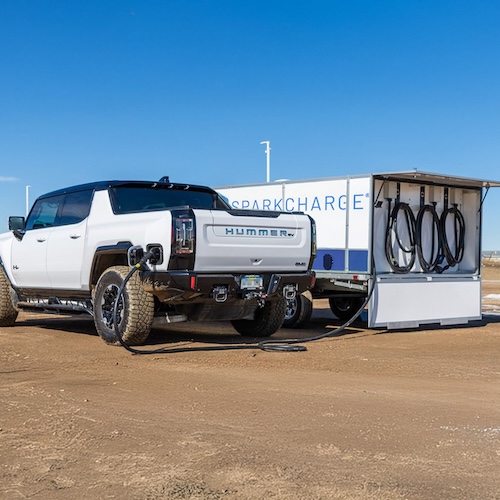

What are the company’s core products and features? Aviv explained:
“At SparkCharge, we offer a variety of Charging-as-a-Service (CaaS) offerings that include:
- Mobile Battery Charging: A mobile battery-powered DCFC solution that charges up to 125kW for fleets.
- Off-Grid Power Hub: A microgrid solution capable of delivering 180 kW+ speeds with an unlimited energy capacity, completely independent of the grid.
- Permanent Infrastructure: A solution that enables your business to start with mobile charging and install the charging stations that are used for mobile charging when your grid power becomes available.
All of our offerings feature customized service options tailored to the needs of your business. Choose between white-glove delivery, self-managed or a hybrid approach for your operations. We take pride in offering the most flexible, scalable and cost-effective suite of EV charging services on the market today.”


Challenges Faced
Have you faced any challenges in your sector of work recently? Aviv acknowledged:
“Absolutely, one of the biggest challenges is the slow pace of fixed infrastructure build-out. It creates real gaps for fleet operators who are ready to electrify but can’t wait 6–24 months for traditional chargers. Our model is designed to close those gaps and help fleets scale today, not years from now. We’ve also navigated policy uncertainty at the federal level by staying laser-focused on meeting actual market needs with a flexible service model.”
Evolution Of The Company’s Technology
How has the company’s technology evolved since its launch? Aviv noted:
“We started with the Roadie Portable, and that product really opened the door for mobile DC fast charging. But we’ve evolved significantly; we’re now a full-service Charging-as-a-Service provider. Our model is built on scalable DC fast charging systems that enable fleets to deploy charging in 14 days, with white-glove support to ensure reliability and uptime. It’s a complete transformation from product-based sales to service-based partnerships.”
Significant Milestones
What have been some of the company’s most significant milestones? Aviv cited:
“To date, we’ve raised over $50 million in funding from top-tier investors like Mark Cuban, Pendulum, Monte’s Fam, Horizon, LG Electronics and Cleveland Avenue. We’ve delivered over four million kWh to customers across North America and continue to expand our fleet partnerships. Becoming the world’s largest off-grid EV fleet charging network and securing partnerships, such as the Masters Tournament, have been major milestones for us.”
Customer Success Stories
Can you share any specific customer success stories? Aviv highlighted:
“We work with some of the most innovative fleets in North America, many of whom came to us because they needed a way to deploy charging quickly. For example, we helped a major last-mile delivery fleet add hundreds of EVs in record time by deploying our Off-Grid Power Hubs at key depots, bypassing permitting delays and grid constraints. The result? Zero downtime, 99% uptime, and faster electrification.”
Funding/Revenue
Are you able to discuss funding and/or revenue metrics? Aviv revealed:
“We’ve raised $55 million to date, backed by incredible investors including Mark Cuban, Pendulum, LG Electronics, and Cleveland Avenue. This funding is helping us scale our services across all 50 states, Canada, and Mexico.”
Total Addressable Market
What total addressable market (TAM) size is the company pursuing? Aviv assessed:
“The market opportunity is massive because every fleet moving toward electrification represents a potential customer. Given the growing demand for EV fleet solutions, we see billions of dollars in TAM across North America, particularly in logistics, last-mile delivery, municipal fleets and rideshare.”
Differentiation From The Competition
What differentiates the company from its competition? Aviv affirmed:
“Our model is faster, more flexible and more scalable than any other solution out there. We can deploy DC fast charging in as little as 14 days, with no upfront capital costs and no dependency on the grid or lengthy infrastructure. Fleets only pay for the power they use. Our white-glove service, in which SparkCharge staff actually handles the charging, takes the operational burden off our customers so they can focus on running their business. We reach places fixed chargers simply can’t—giving our partners a competitive edge.”
Future Company Goals
What are some of the company’s future goals? Aviv emphasized:
“We’re continuing to build strategic partnerships and expand our fleet services across diverse industries. Our goal is to be the go-to partner for fleets looking to electrify, no matter where they operate or their pace of expansion. We’ll continue to strengthen our product offerings and grow our presence across North America.”
Additional Thoughts
Any other topics you would like to discuss? Aviv detailed:
“I think the future of mobile EV charging is incredibly exciting, especially for last-mile delivery, autonomous fleets and emerging markets where grid access is limited. Flexibility is key. Fleet operators need charging that adapts to their business, not the other way around. That’s where we see SparkCharge continuing to lead. Fixed infrastructure alone won’t provide comprehensive coverage for the commercial market for many years to come. Our model fills that gap today.”
Future Of Last-Mile Delivery
How do you see mobile EV charging fitting into the future of last-mile delivery or autonomous fleets? Aviv predicted:
“The future of last-mile delivery and autonomous fleets is built on speed, efficiency and adaptability, and mobile EV charging is the backbone that makes that possible. These fleets operate in dynamic environments where routes shift daily, demand spikes unexpectedly and downtime is not an option. Traditional infrastructure simply can’t keep up with that level of agility.”
“That’s where mobile EV charging comes in. It brings the power to where it’s needed, when it’s needed, no fixed stations, no permitting delays, no grid dependence. As these fleets scale, they need charging solutions that scale with them instantly. Mobile charging makes last-mile electrification not just possible, but profitable.”
“Autonomous fleets, especially, will rely on charging-as-a-service models that allow them to focus on operations while partners like SparkCharge handle energy delivery. In that world, charging becomes a utility, automated, reliable and invisible. That’s exactly the future we’re building.”
Long-Term Profitability Of Commercial Fleet Electrification
How important is charging flexibility to the long-term profitability of commercial fleet electrification? Is permanent infrastructure anywhere close to providing comprehensive charging coverage in the US? Aviv concluded:
“Charging flexibility is the make-or-break factor in the profitability of fleet electrification. Fleets need energy on their terms: at the right location, at the right time and at the right speed. If you can’t deliver that, you’re either losing money on downtime or overinvesting in infrastructure that won’t scale with your needs.”
“Right now, permanent infrastructure isn’t even close to providing the comprehensive coverage that commercial fleets require. We’re decades away from a grid that’s fully built out, accessible and fast enough to support the demands of large-scale electrification. And fleets can’t wait.”
“That’s why we created SparkCharge, to fill that critical gap. Our mobile and off-grid solutions let fleets electrify without delay, avoid massive capital investments and adapt as their operations grow. Charging needs to work around your business, not the other way around. That’s the future we’re delivering today.”

