

Spellbook is the leading AI infrastructure for contract workflows that is deeply integrated into Microsoft Word and Google Docs and supports contract drafting, review, negotiation, and transactional workflows, saving teams upwards of 84% on contract reviews or a full day per week on average. The company launched the first generative AI tool for lawyers in 2022 and now serves more than 5,000 in-house teams and law firms across 80 countries. Pulse 2.0 interviewed Spellbook Co-Founder and CEO Scott Stevenson to learn more about the company’s growth, its $40 million debt financing from RBCx, acquisition strategy, legal AI market consolidation, and plans to reach $100 million in annual recurring revenue.
Scott Stevenson’s Background

Screenshot
When asked about his background, Stevenson shared:
I’m CEO and co-founder of Spellbook. The short version is that at a previous startup, half our angel round went to routine legal paperwork. Most expensive bill we’d ever seen, least value delivered.
And that experience isn’t unusual: 60% of small businesses won’t even call a lawyer because they can’t afford to. That stuck with me.
We started the company in 2018, originally called Rally, and launched the first generative AI tool for lawyers in summer 2022, a few months before ChatGPT came out.
So we’ve been at this longer than most people realize. Now we have more than 5,000 customers in 80 countries, and are beginning to gain industry recognition, including the inaugural Built in Canada Rocketship award for Canada’s fastest-growing company and my inclusion on Financial Post and Caldwell Partners International Inc.’s Canada’s Top 40 Under 40 list.
$40 Million Debt Financing
When asked what drove the decision to raise $40 million in debt financing from RBCx so soon after Spellbook’s $50 million Series B, Stevenson explained:
Growth has accelerated faster than what we expected.
We’re on track to hit $100 million ARR this year after tripling revenue in 2025, and we started seeing a real opportunity to acquire smaller competitors.
The market matured very quickly, leaving competitors with good products unable to get a real foothold in the market.
Debt was the right instrument for that since it lets us move on M&A without diluting our shareholders.
RBCx got it and moved quickly.
Deploying The New Capital
When asked how Spellbook plans to deploy the new capital, particularly around pursuing up to five acquihires over the next two years, Stevenson said:
Acquisitions are the primary focus.
The legal AI market matured really quickly, and a lot of smaller companies spun up.
We expect to do roughly five deals over two years, around $60 million in total spend, though that could shift.
We’re already looking closely at two targets right now, and once every two weeks or so we hear from a company that wants to be acquired.
We’re also hiring aggressively with plans to expand our team to 250 people by year-end, which doubles our team.
Acquisition Targets
When asked what types of companies or capabilities Spellbook is targeting through these acquihires, Stevenson explained:
Contract-focused legal AI companies, primarily.
Teams that have built something meaningful in adjacent parts of the contract lifecycle.
We want talent and technology that help us expand beyond review into the full scope of transactional work.
The key filter is teams that share our philosophy: build AI that fits inside existing workflows rather than asking lawyers to change how they operate.
Early-Mover Advantage
When asked how launching a generative AI tool for lawyers before ChatGPT shaped Spellbook’s growth and product development, Stevenson said:
The biggest thing it gave us is data.
We’ve analyzed over 10 million contracts now, and our suggestion acceptance rate has gone from 5% to 55%.
That feedback loop compounds: every time a lawyer, HR, procurement, or sales professional accepts or rejects a suggestion, the system gets smarter and more calibrated to how they actually work.
That’s very hard to replicate if you’re starting from scratch today.
It also gave us conviction early about what works.
We knew lawyers and in-house weren’t going to adopt some new platform. They needed AI that lives in Microsoft Word and Google Docs, where they already spend their day.
Same philosophy as Cursor for developers. That’s been core to our product from the start.
Path To $100 Million ARR
When asked about the key drivers behind Spellbook’s rapid growth and path toward $100 million ARR, Stevenson explained:
A few things working together.
Product-led growth is a big one: time to value is about two minutes.
Lawyers try it and immediately start catching things they would have missed.
The expansion into in-house legal has been huge too.
In-house teams now represent more than 50% of revenue since we launched Playbooks in 2024.
That opened us up beyond law firms to HR, procurement and sales teams — anyone involved in getting a contract to signing.
And the market has shifted.
Clients now ask their lawyers what AI tools they’re using. It’s table stakes.
That demand pull has been a meaningful tailwind.
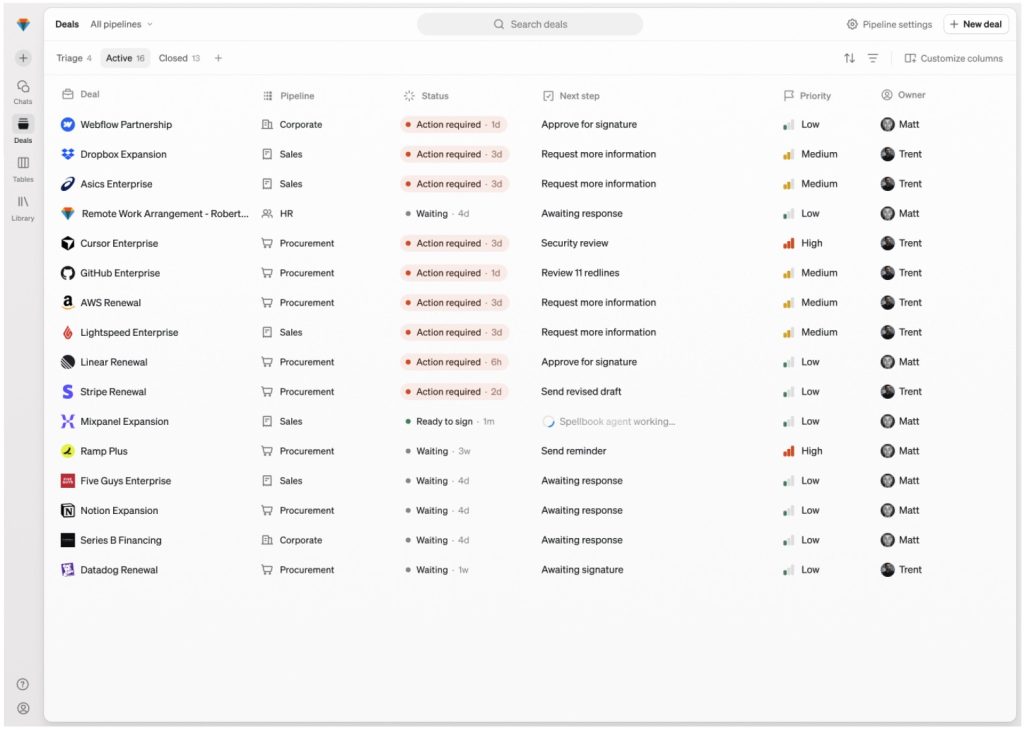
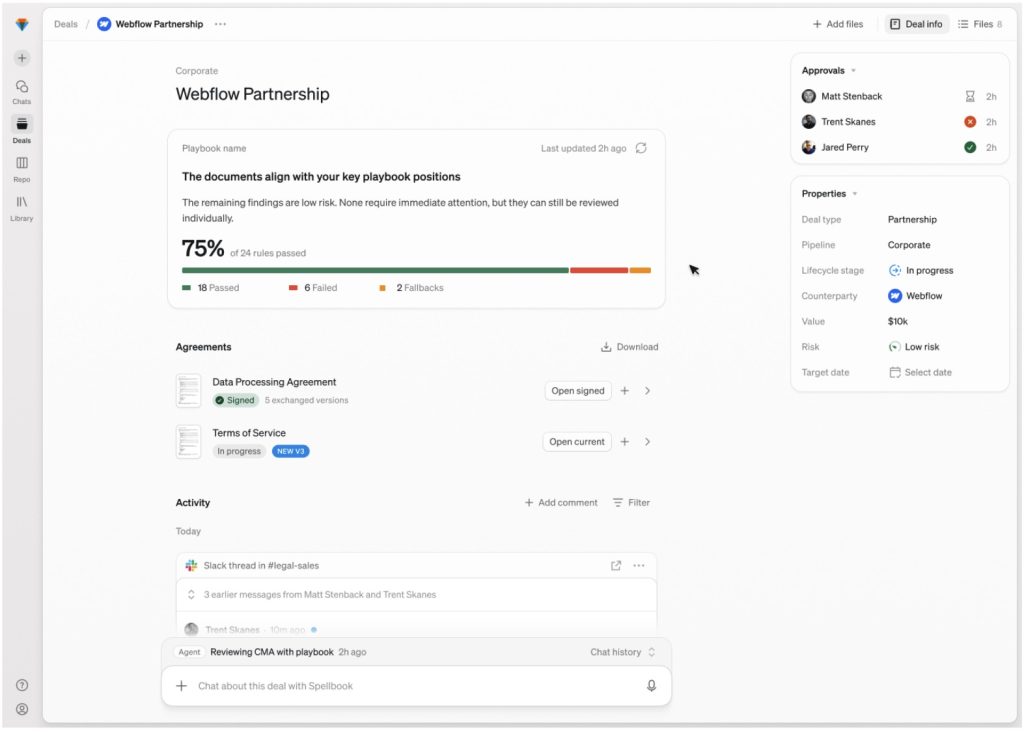
Looking ahead, 2027 is about continuing to prove our thesis as a proactive agent since we just launched Autonomous Contract Management (ACM), the first AI-native CLM alternative that supports the entire contract lifecycle, from intake to negotiation to analysis, all while remaining proactive with reminders and risk monitoring to alleviate the cognitive load for teams. ACM works on day one and runs autonomously in the background, intaking and reviewing contracts so deals keep moving forward.
To get there we’re doubling headcount this year to build a world-class team that can meet the demand we’re seeing, including appointing the former Shopify and Atlassian CTO Jean-Michel Lemieux to a new role built for AI-native companies, Executive Individual Contributor (EIC), and our first-ever CMO Meltem Kuran-Berkowitz.
What Customers Value Most
When asked what Spellbook’s more than 5,000 law firms and in-house teams across 80 countries find most valuable about the platform, Stevenson said:
It works where they already work.
That sounds simple, but it’s a big deal in a profession that’s been burned by technology that overpromises.
No platform migration, no months-long rollout, no change management.
You install it in Word or Google Docs and you’re up and running.
The other thing is data-grounded suggestions.
When Spellbook flags something unusual in a contract, lawyers can see how it compares to real-time market standards.
That’s the difference between an AI giving you a guess and giving you evidence you can actually cite in a negotiation.
Legal AI Market Consolidation
When asked how he sees the legal AI market evolving over the next few years and where Spellbook fits into the consolidation trend, Stevenson explained:
A lot of companies spun up quickly, but most are going to struggle to survive.
Building a legal AI product is one thing. Building the data and distribution to sustain it is something else.
We’re already seeing companies come to us looking to be acquired, and I think that accelerates from here.
We have more customers than Harvey and Legora combined, and 4x more enterprise in-house customers than either.
That matters because in-house legal is ultimately a much bigger market: think of it like the OpenAI vs. Anthropic dynamic, where the real prize is enterprise adoption, not just selling to one segment.
We’re the exclusive AI partner of the Canadian Bar Association, over 40,000 members, and we’re backed by Khosla Ventures at a $350 million valuation.
We’re in a strong position to be a consolidator.
Competitive Differentiation
When asked what differentiates Spellbook from the growing number of AI tools entering the legal market, Stevenson highlighted three areas:
- First, we’re in Word and Google Docs. Like Cursor for developers, we enhance the tool lawyers, HR, procurement, and sales professionals already use instead of asking them to learn something new. That’s why adoption is so fast.
- Second, our data. 10 million contracts analyzed, with a suggestion acceptance rate that’s gone from 5% to 55%. Every interaction makes the system better. Competitors relying on generic LLMs can’t match that.
- Third, we’re evolving beyond copilot into a proactive agent. We’ve created ACM, a platform that works on in-house teams’ contract flow continuously, surfacing risks, flagging deadlines, and accelerating deal cycles, without needing to be prompted at every step. Most legal AI tools still require a lawyer to ask a question. We want Spellbook working in the background, all the time.
And we cover the full contract workflow, drafting, review, negotiation support, and with Spellbook Associate, multi-document transactional work.
That’s useful to lawyers, but also to HR, procurement and sales teams. It’s a broader market than most legal AI companies are going after.
ARR Reporting In AI
When invited to discuss another topic, Stevenson highlighted what he sees as an important distinction between ARR and contracted annual recurring revenue, or CARR:
There’s an important conversation happening right now about what ARR actually means in AI, and I don’t think enough people are being honest about it.
One issue is people reporting CARR, Contracted Annual Recurring Revenue, as ARR.
CARR counts revenue from contracts that have been signed but not billed yet. Used properly, it’s a legitimate metric, especially in sectors like healthcare AI or energy optimization where revenue accrues gradually over long deployments.
The problem is how it’s being reported.
In a lot of investor decks, CARR and ARR show up as separate line items. But when companies go to press, they report CARR and call it ARR to get the biggest possible headline number.
I know of a handful of cases where the gap between the two figures is 3 to 5x.
It takes a few different forms.
A startup might count a full year of revenue on a contract where the customer can opt out after one month.
Or book a free three-month pilot as three months of paid revenue.
Some of this may have started innocently, for example, companies trying to get a little extra credit for signed deals that weren’t live yet.
But the gap has grown massively, and in a frothy AI market where everyone’s racing to show traction, it’s become a real problem.
The knock-on effect for the AI SaaS market is what worries me.
When inflated CARR figures set the benchmark for what good looks like, every other founder feels pressure to match numbers that aren’t real.
Investors price rounds against fake comps. Journalists print headline figures that don’t reflect cash coming in the door.
And eventually the gap between reported revenue and actual revenue catches up, usually at the worst possible time, when growth slows or pilots don’t convert.
For investors and reporters trying to sort through this: ask whether the number includes contracts that haven’t been billed yet, and how much.
Ask what percentage of “ARR” would survive if every customer exercised their opt-out clause tomorrow.
The answers should be easy to give. When they’re not, that tells you something.
