

Starship designs and operates fleets of six-wheeled autonomous robots that deliver food, groceries, and other supplies across suburban neighborhoods, cities, and industrial sites. Its delivery system combines fleet orchestration, Level 4 autonomous robots, and logistics operations to automate last-mile delivery. Pulse 2.0 interviewed Starship VP of Hardware Engineering Chris Smith to learn more.
Chris Smith’s Background
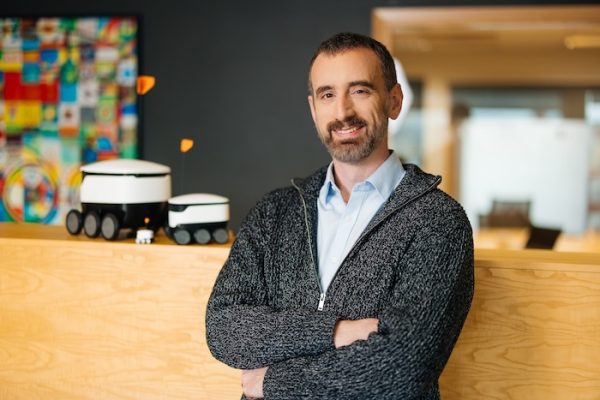
When asked about his background and the experiences that shaped his approach to engineering, Smith shared:
I’ve spent my career working on complex systems where performance, safety, and reliability all have to come together, in industries including aerospace, defense, and consumer products. I’m drawn to roles that require a deep understanding of hardware, software, and the realities of how systems operate in the real world.
I’ve built high-performing organizations and led multidisciplinary engineering teams at Dyson, delivering complex products at scale. What’s stayed constant is my focus on autonomous systems and understanding how decisions and physical design come together to create something that really works for the customer outside of a lab.
My role at Starship gives me the perfect opportunity: building pragmatic solutions that work safely, technically, and at scale in everyday life.
Primary Responsibilities
When asked about his primary responsibilities at Starship, Smith explained:
Starship reimagines how goods move through communities. Our robots fit into existing delivery ecosystems and automate the last mile in places where cost or access have been barriers, including suburban neighborhoods and industrial sites.
At Starship, I lead the hardware engineering organization, spanning system architecture, mechanical design, and electronics to sensors, functional safety, and reliability. I focus on the team and how we work, making sure engineers have a clear direction and are set up to deliver quality work.
Another big part of my role is making sure we’re building systems that are technically sound, cost-effective, and manufacturable. That means balancing long-term innovation with short-term execution, so progress stays steady while solving the right problems.
A Memorable Introduction To Starship
When asked about his favorite memory from working at Starship, Smith recalled:
It is difficult to single out one event. We have had great successes like starting operations in Germany, too many interesting engineering conversations to count, and I had lots of fun going curling with my team.
My favorite is from my first discussion with Ahti Heinla, our Founder and CEO. He showed me the hypervisor panel, which is like air traffic control, for a thousand robots. We picked one and watched it autonomously deliver some groceries down a sidewalk. It avoided some pedestrians and then crossed the road. We picked another robot, and this time it was in the snow, and the next one was operating at night. It became clear to me at that point that Starship is a logistics company that uses robots, rooted in a real commercial need and enabled by truly cutting-edge technology.
Core Products And Features
When describing Starship’s core products and capabilities, Smith detailed:
At our core, we design and operate fleets of six-wheeled autonomous robots that deliver food, groceries, and supplies.
It is interesting to see all the components come together. First, there is a complex fleet orchestration system that manages thousands of robots and tens of thousands of orders. Second, there are the robots themselves, operating at Level 4 autonomy with cameras, radar, and sensors to detect anything in their path. Finally, there are the logistics and operations teams needed to operate, clean, and maintain the robots and support our customers.
Focusing on the robots, we designed them to be efficient and practical, so each one can carry up to 22 pounds, operate for more than 18 hours between autonomous recharges, move at a safe walking pace, and typically use less energy per delivery than boiling a kettle.
Navigating Regulatory Challenges
When asked about recent challenges in the autonomous delivery sector and how Starship addressed them, Smith observed:
One of our earliest and biggest hurdles wasn’t technical; it was legal. In the U.S., sidewalk delivery robots are regulated state by state, with no national framework. For a company building fully autonomous robots to safely navigate neighborhoods at scale, that patchwork made things complicated.
At Starship, we embrace the need for consistent, practical regulation, so instead of waiting for regulators to catch up, we got to work. In 2017 and 2018, we worked with lawmakers in states like Wisconsin and Florida to help draft some of the first laws that legalized sidewalk robots under strict safety and size requirements. We designed our robots to meet those standards from the start, which allowed us to grow without cutting corners.
Today, 25 states and Washington, D.C., have frameworks that allow autonomous delivery robot operations, many modeled on those early laws we helped shape. The experience taught us that designing a breakthrough product is really about adaptability. Operating legally and safely are equal parts of the equation. Our robots are engineered to account for random, real-world variables, from low-visibility pedestrians to unexpected obstacles. That collaboration between technology and policy became a cornerstone of Starship’s approach: build with communities, not just for them.
Technology Evolution
When discussing how Starship’s technology has evolved since its launch, Smith described:
When we launched in 2014, we were working with early prototypes, trying to prove the concept and develop the key technology blocks. Therefore, to keep everyone safe, humans supervised the robots.
Over the years, we’ve made the robots more reliable, added more safety and redundancy, increased weather resistance, improved obstacle detection, and used our vast datasets from millions of deliveries to refine our AI to handle complex urban environments.
Fast-forward to today, and what started as food delivery on college campuses has grown to include grocery delivery in towns and cities across Europe. We’re now completing more than 125,000 road crossings per day. That’s about two crossings per second, and 99% happen without any human intervention.
Major Company Milestones
When asked about Starship’s most significant milestones, Smith highlighted:
As of this year, we’ve completed more than tenmillion deliveries and driven over 14 million miles worldwide.
Today, our robots operate in more than 300 locations across eight countries, making us the only company delivering autonomously at this scale in real-world environments.
In 2025, our robots traveled 1.5 million miles for U.S. students in all types of weather. We surveyed close to 5,000 U.S. college students, and the data told us that there’s a generational shift in how humans are living with robots. Of the students surveyed, 97% stated that they love or “like” the robots. That kind of approval is rare for any kind of AI technology.
In Europe, we’ve seen similar momentum with our grocery partners. Our partnership with Finland’s S Group scaled from a small pilot to more than 650 robots across 140 stores, making it one of Europe’s most ambitious retail technology rollouts. We launched Europe’s first robot-enabled grocery delivery service with Bolt in Estonia, expanded into Sweden with foodora, and in December 2025, we announced a partnership with Uber Eats that started in the U.K., with more countries joining this year and the U.S. expected to follow in 2027.
We’re also pioneering industrial delivery with partners like WACKER, where robots transport laboratory samples and equipment across manufacturing campuses, completing around 100 deliveries weekly with more than 95% full autonomy.
Starship’s Differentiators
When asked what differentiates Starship from its competition, Smith emphasized:
We’ve been doing this longer and at a larger scale than anyone else. Starship has the world’s largest autonomous delivery fleet, with more than 3,000 robots, over 10 million deliveries completed, and 11 years of real-world operations. Our robots are trusted by customers, grocers, delivery platforms, and industrial sites across eight countries.
But what really stands out to us is the culture we’ve created. They’ve become a part of daily life in the communities we serve. Customers give them nicknames: “TOBOR” at UT Dallas and “ZotBots” at UC Irvine. People help them when they need it, take selfies with them, and treat them like neighbors. According to the survey I mentioned earlier, 72% of students described them as “friendly/cute,” and 65% reported that their opinion became “more positive since seeing or using them.” Nearly 40% of students say delivery robots improve food accessibility, while one in four report feeling safer using contactless delivery, particularly during late-night study sessions or poor weather.
Beyond this, our robots appear in pop culture, movies, and social media. We’ve proven that autonomous technology doesn’t have to feel cold or disruptive. It can feel welcoming, like a friend.
Future Goals
When discussing Starship’s future goals, Smith concluded:
We have ambitious plans, but we’re motivated more than ever to continue building the infrastructure that makes cities more livable and sustainable for everyone. Our vision is that sidewalk robots will become as familiar as rideshare vehicles. You’ll just expect to see them outside your home.
The global autonomous last-mile delivery market was valued at $18.7 billion in 2023 and is projected to reach $144.2 billion by 2033. In Europe alone, we’re working with 100,000 convenience stores in our top six countries. Even capturing 15% of that footprint represents a billion-dollar revenue opportunity.
It’s a big step up, but one we believe the demand and excitement for the robots support.
