

Subsense is developing NanoBCI, a bidirectional brain-computer interface designed to read neural signals, decode them, and eventually send information back to the brain without requiring brain surgery. The company is initially targeting medical applications such as Parkinson’s disease, with a longer-term vision of creating a consumer brain-computer interface for communication, AI interaction, and digital environments. Pulse 2.0 interviewed Subsense CEO and Co-Founder Tetiana Aleksandrova to learn more about the company’s technology, nanoparticle-based approach, and vision for the future of brain-computer interfaces.
Tetiana Aleksandrova’s Background

When asked about her background, Aleksandrova shared:
I have spent almost the last decade in neurotechnology, but I think the reason I ended up here is both very rational and not rational at all.
I always wanted to build something very big. Not just another product or another company, but something that could become a fundamental technology for humanity. And neurotechnology felt like one of those rare areas where that was possible.
But I was also always a bit of a dreamer. I loved movies about the future, new technologies, space, all the slightly crazy ideas about what humans could become. I was always much more interested in what does not exist yet than in making something that already exists a little bit better.
My first BCI company was Neiry, which I started around eight years ago. We were building non-invasive brain-computer interfaces, mostly around EEG. It was an incredible education, but it also showed me the limitations of working only from the surface of the head.
You can build useful things, but at some point, you hit a ceiling in signal quality and in how deeply you can interact with the brain.
Then, in the first days after the war between Russia and Ukraine started, I made the decision to leave and move to the United States. I never moved back.
It was a major reset in my life, but it also gave me the chance to rethink what I wanted to build next and how ambitious I wanted to be.
When I came to America, I basically started from scratch. New country, new team, new company, new technology.
And the question behind Subsense was much more ambitious: can we build a brain-computer interface with the performance people expect from invasive systems, but without brain surgery?
That is what I have been working on ever since.
How Subsense Started
When asked how the idea for the company came together, Aleksandrova explained:
It actually did not start with nanoparticles. It started with the kind of BCI I wanted to exist.
Subsense is my second brain-computer interface company. With my first company, I spent years working with non-invasive technology, mostly EEG, and I saw both what it can do and where it starts to hit very real limitations.
When I moved to the U.S. and decided to start again, I did not want to build another version of the same thing. I wanted to start from the product and work backward to the technology.
For me, a real BCI platform has to do two things at the same time. It has to get much closer to the quality and precision you can get from invasive systems, but it also has to be something millions of people could realistically use one day.
And I just do not believe millions of people are going to have brain surgery.
So that became the problem: how do you get very close to neurons without permanently implanting electronics into the brain?
Artem Sokolov, my co-founder, and I started looking at the problem from that direction. Not “how do we make EEG a little better,” but what completely different architecture could make this possible?
That is what eventually brought us to nanoparticles.
The idea was to move the smallest part of the interface close to the neurons, while keeping the actual hardware outside the body.
That was really the beginning of Subsense.
Favorite Memory
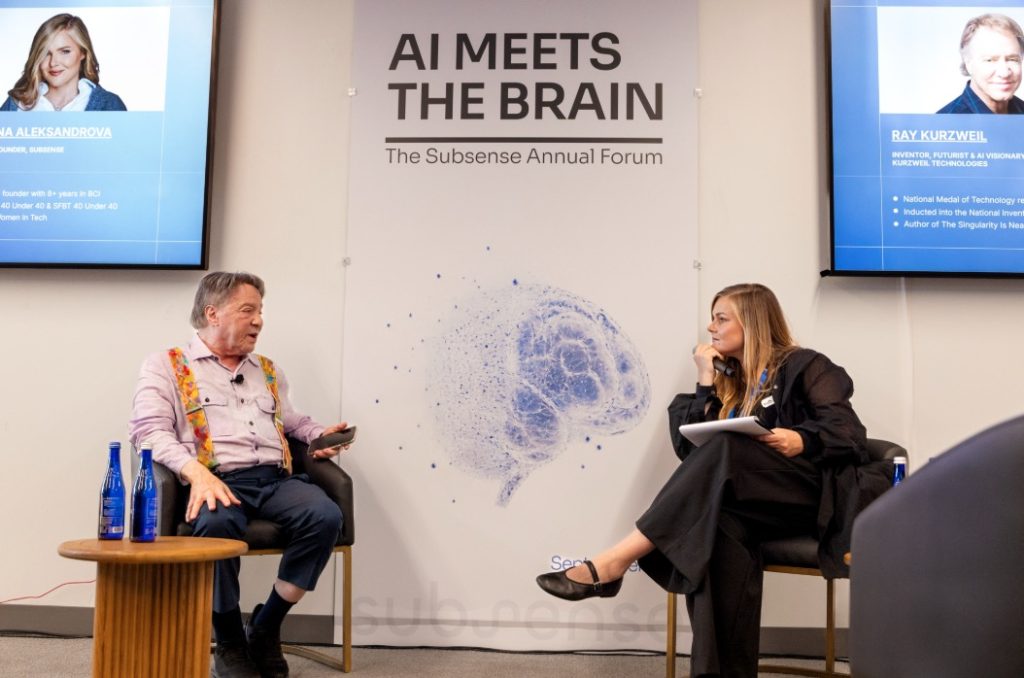
When asked about her favorite memory working for the company so far, Aleksandrova said:
Honestly, probably very recently, when we hosted the Subsense Forum for the second time.
We did the first one a year ago, last September, and I remember that event very clearly. At the time, there were only nine people. We had just one lab. We were only starting our work in cells.
And then this year I was standing there looking around and realizing how much had changed in twelve months.
Now we are almost 40 people. We have two labs. We are actively doing in vivo work in mice and already moving toward larger animal studies.
We also recently looked at how quickly we moved through the development process and realized that we got from cell studies to the large-animal stage about 3.5 times faster than other companies in this industry.
The science, the team, the company itself, everything has moved so much faster than I think any of us fully realized while we were inside it.
That was probably the moment when I really stopped and thought: wow, we built all of this in one year.
It felt a little unreal.
Core Products And Features
When asked about Subsense’s core products and features, Aleksandrova detailed:
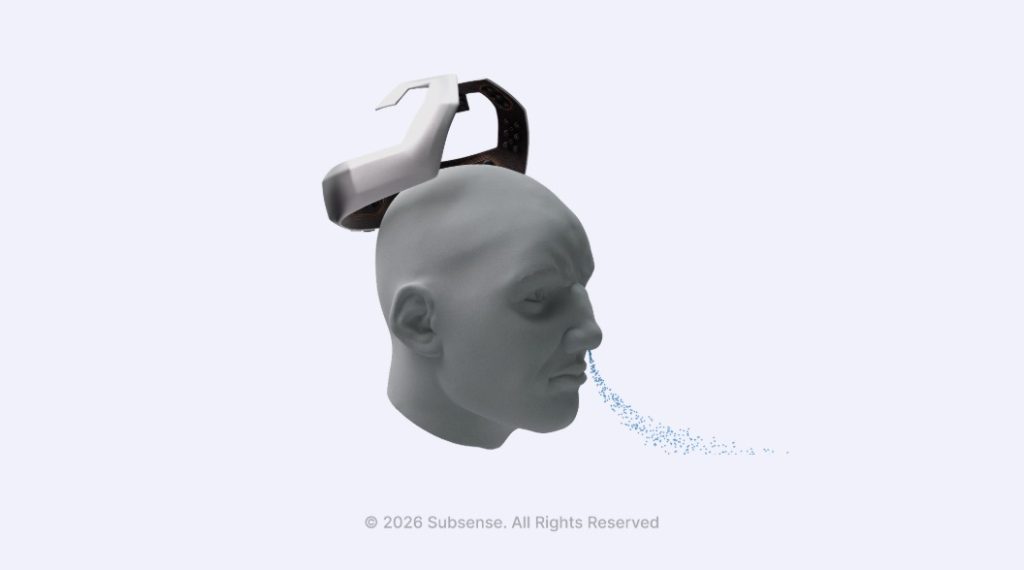
At the simplest level, we are building a communication channel with the brain, NanoBCI.
The goal is to be able to read information from the brain, decode what that signal means, and send information back into it.
Once you can do that through a bidirectional interface, you can build many different applications on top of the same technology.
For example, people could potentially communicate with each other without words, control digital environments directly with their brain, adjust things like focus or relaxation, and eventually have much more direct control over their own brain states.
That is how I think about the product. Not as one device for one disease, but as a platform.
We are starting with medical applications, starting with Parkinson’s disease, because that is where the need is most obvious and where we can prove safety and efficacy very rigorously.
But long term, we are building toward a consumer device and a completely new way for humans to interact with technology, with AI, and eventually with each other.
The most important feature is that we are trying to do this without brain surgery. Because if BCI is ever going to become a mass-market technology, I don’t think surgery can be part of the user experience.
Building Credibility In BCI
When asked about challenges in the brain-computer interface sector and how Subsense has approached them, Aleksandrova explained:
I think the biggest challenge in BCI right now is credibility.
The field has had a lot of very big promises, and when you are building something as unusual as we are, the first reaction from many people is naturally: does this actually work?
I think that skepticism is healthy.
The only real way to overcome it is data. We try to be very disciplined about separating what we believe is possible from what we have already demonstrated.
And because our technology combines neuroscience, nanotechnology, hardware, optics, magnetics and AI, there is no single experiment that proves the whole thing.
You have to break a very complicated system into smaller problems and solve them one by one.
That is basically how we operate. We set very concrete technical milestones, build the infrastructure to test them ourselves, and keep moving from simulation to cells, from cells to animals, and from one piece of evidence to the next.
For me, the best way to make something that sounds like science fiction credible is to slowly turn every part of it into data.
How The Technology Has Evolved
When asked how Subsense’s technology has evolved since launching, Aleksandrova said:
When we launched, a lot of the technology still existed as separate pieces: nanoparticle chemistry, simulations, early biological work, hardware concepts.
Over the last year, those pieces have started turning into an actual system.
We moved from early work in cells into in vivo studies in mice, and now we are preparing for larger animal work.
We also opened two labs in Silicon Valley, which gave us much more control over the experiments and let us iterate much faster.
The other big change is how we think about the technology itself.
At the beginning, the easiest way to explain Subsense was as a non-surgical alternative to implanted BCIs. I do not think that description is big enough anymore.
What we are building is a bidirectional communication layer with the brain: something that can read neural signals, decode them, and eventually send information back.
Once that works reliably, you can build many different applications on top of it.
The technology has evolved from a very ambitious scientific idea into something that is starting to look much more like a platform.
Key Company Milestones
When asked about some of Subsense’s most significant milestones, Aleksandrova highlighted:
I think the most important milestones have been the moments when we removed a major question mark around the technology.
The first was showing that the underlying physics worked well enough to build a company around it.
Then came biological validation. Moving from simulations and chemistry into living systems was a huge step, because that is where a beautiful idea can very quickly fall apart.
Another major milestone was moving into in vivo work and starting to see the different parts of the system work inside an animal, rather than only in isolation.
And more recently, bringing people like Ray Kurzweil into the company has been meaningful in a completely different way.
Not because it proves the science, but because it helps us think much further ahead about what this technology could become if we succeed.
There are many smaller milestones in between, but those are the ones that really changed how I saw the company at each stage.
Preclinical Progress
When asked to share specific customer success stories, Aleksandrova emphasized the company’s current stage:
Not yet, and I want to be precise about why. We are in preclinical research.
We have no patients, no users and no customers, and anybody in this field who claims otherwise at our stage should be asked hard questions.
What we can point to is the science.
The particles are biocompatible in the systems we have tested. We are reading and stimulating in animals.
The first human stories are years out, and they will come out of tightly controlled clinical settings.
Funding
When asked about Subsense’s funding, Aleksandrova revealed:
We raised a $17 million seed in February 2025, led by Golden Falcon Capital, and grew that to $27 million by December 2025.
Total Addressable Market
When asked about the total addressable market Subsense is pursuing, Aleksandrova explained:
I do not really think about our TAM as one number.
There is the market we enter first, and there is the market this technology could ultimately create.
We start in medicine, because neurological disease gives us very clear problems to solve and very clear ways to measure whether the technology works. That alone is a very large market.
But that is not the reason I started the company.
If you eventually have a safe, non-surgical way to read from the brain, decode that information, and send information back, then you are no longer talking only about a medical device.
You are talking about a new interface between humans and computers.
That opens completely different categories: communication, control of digital environments, interaction with AI, cognitive applications, and eventually things we probably cannot define very well yet.
The near-term market is neurological disease. The long-term market is much closer to the future of human-computer interaction itself.
And that is obviously much, much bigger.
Competitive Differentiation
When asked what differentiates Subsense from its competition, Aleksandrova said:
I think the biggest difference is that we are trying to break the main tradeoff that exists in BCI today.
Historically, you basically had two choices.
You can go invasive and get much better access to the brain, but then you need surgery and permanent hardware.
Or you can stay completely outside the body, which is much easier for the user, but the signal is much more limited.
We are trying to create a third option.
Our approach is non-surgical, but it is designed to interact with the brain much closer to the source than traditional non-invasive systems.
And because the particles are temporary, we are also not asking someone to permanently install electronics in their brain.
The other important difference is that we are building a bidirectional system from the beginning.
We do not only want to read neural activity. We want to be able to decode it and send information back.
So, for me, the differentiation is not one feature. It is the architecture.
We are not trying to make an implant slightly less invasive or make EEG slightly better.
We are trying to build a different way of connecting to the brain altogether.
And if it works at scale, that changes not only the technology, but who can realistically use a BCI.
Future Goals
When asked about Subsense’s future goals, Aleksandrova explained:
The first goal is very concrete: prove the full system end to end.
Not one particle, one signal, or one experiment in isolation, but the whole thing working together: getting the particles where we need them, reading neural activity, decoding it, and sending information back.
After that, the goal is to make it clinical grade.
That means safety, reproducibility, manufacturing, larger animal studies, and eventually getting to humans.
But that is still only the first chapter for me.
Long term, I want Subsense to build a real consumer brain-computer interface.
Something that is not only used when something is wrong with your brain, but something people could eventually use to communicate, interact with AI, control digital environments, or change their own cognitive state.
I think BCI can become one of the foundational technologies of the next era.
So, the goal is not just to build a successful medical device company. The goal is to build the interface itself.
Safety, Privacy And Trust
When invited to discuss another topic, Aleksandrova concluded:
One thing I think we do not talk about enough in BCI is that this could become an extremely intimate technology.
If you are building an interface that can eventually read from the brain and send information back, safety and privacy cannot be things you add later. They have to be part of the architecture from the beginning.
I also think it matters a lot who builds this technology and what values shape it.
I want to build one of the foundational technologies of the next era, but I care just as much about making sure it becomes something people can trust and choose to use.
For me, those two things are not separate.
If BCI is ever going to become a technology used at very large scale, trust is part of the product.
