

Sweep provides an agentic layer that helps organizations understand, change, and govern complex enterprise systems by continuously mapping metadata, dependencies, permissions, automations, and integrations. Pulse 2.0 interviewed Sweep Co-Founder and CEO Ido Gaver to learn more.
Ido Gaver’s Background

When asked about his background and the experiences that led him to establish Sweep, Gaver shared:
I’m Ido Gaver, Co-Founder and CEO of Sweep. Before starting Sweep in 2021, I co-founded a company called Flok that was later acquired by Wix. After the acquisition, I joined Wix and led several initiatives, including B2B strategy and partnerships.
Across those experiences, I saw a consistent pattern inside growing technology companies: Platforms like Salesforce become central to how a business operates, but over time, the system accumulates layers of configuration, automation, and integrations that very few people fully understand.
That complexity slows companies down and increases operational risk. When AI began entering enterprise workflows, it made that problem even more obvious. AI can generate changes and automate workflows incredibly quickly, but without visibility into the systems, particularly dependencies and logic, those changes can introduce risk.
Sweep was founded to solve that problem by giving organizations a clear, real-time understanding of how their systems actually work.
How Sweep Started
When discussing how the idea for Sweep came together, Gaver explained:
The idea came from watching organizations struggle with the complexity they had built over years of scaling their systems.
Platforms like Salesforce are extremely powerful, but they evolve organically. Over time, you end up with hundreds or thousands of automations, custom fields, workflows, integrations, and permission layers. Often, the people who originally built those systems have moved on, and institutional knowledge disappears.
When AI started generating workflows and configurations automatically, it became clear that companies needed a new layer of infrastructure, something that could understand how systems behave before making changes to them.
That insight led to Sweep. We built what we call the agentic layer for enterprise systems, which continuously maps metadata across platforms so teams and AI agents can understand dependencies, simulate changes, and operate safely.
Cybersecurity Adoption
When asked about his favorite memory from working at Sweep, Gaver recalled:
One of the most meaningful moments for me was when we started getting traction in the cybersecurity space, which has been recent.
These companies have some of the most rigorous governance models, and that usually means some of the most sophisticated organizations. Their internal environments are incredibly complex, so seeing them adopt Sweep validated our core thesis: Even the most advanced teams struggle with visibility and governance as their systems scale.
It was a reminder that the problem we’re solving isn’t niche. It’s something that really does affect every enterprise that runs mission-critical operations on large platforms.
Core Products And Features
When asked about Sweep’s core products and features, Gaver detailed:
Sweep is the agentic layer for your enterprise systems. It’s where teams and metadata agents plan, change, and govern systems.
The core problem we solve is what we call the Context Gap: Enterprise systems are fragile because metadata is fragmented across objects, automations, permissions, and integrations, and AI magnifies that risk.
Our platform addresses this through three capabilities: Connect, Contextualize, and Act.
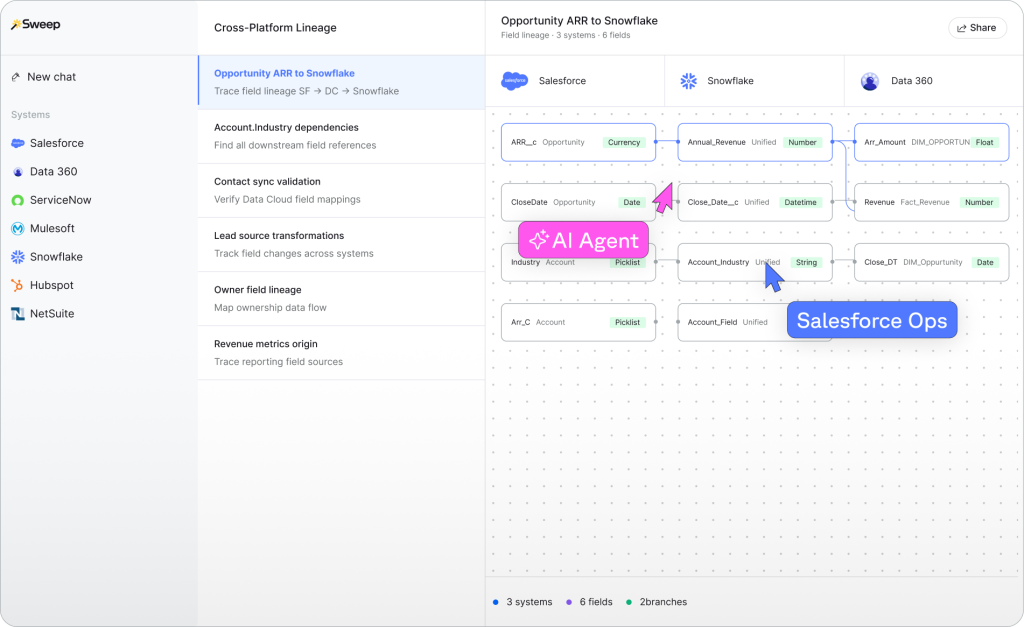
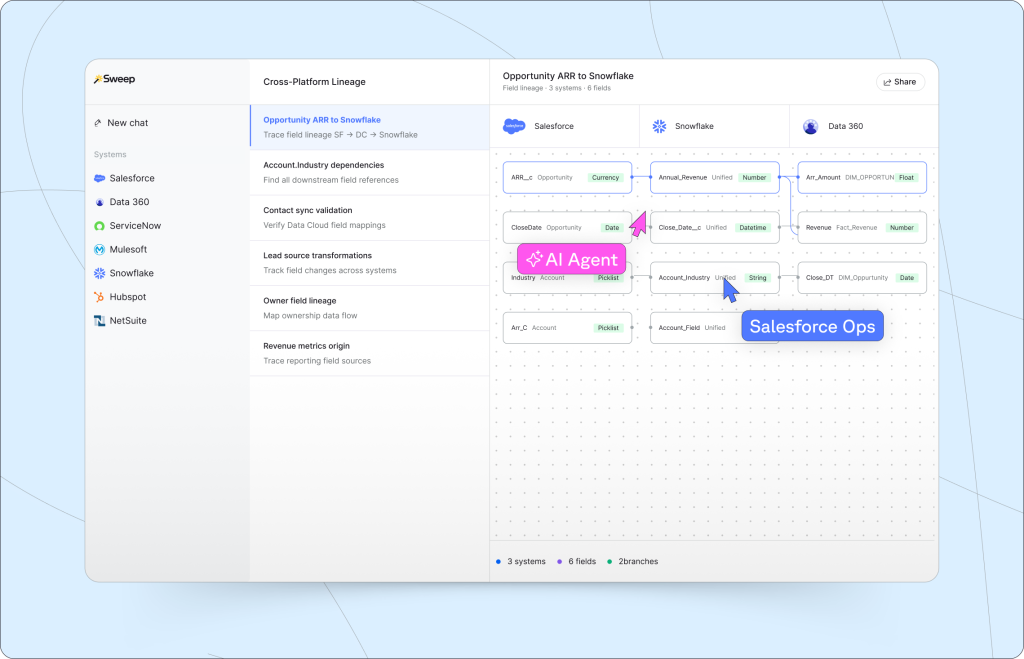
Customers connect by continuously ingesting metadata across every supported system, including Salesforce, Snowflake, ServiceNow, and more.
They contextualize when we map dependencies and business logic into a shared model so teams and agents understand how systems actually behave.
And they can act safely, simulate impact, and implement changes without guessing.
On top of that sit our Metadata Agents, purpose-built for documentation, monitoring, permissions, process analysis, and user support, alongside Agentic Ops capabilities that handle routing, automation, alerts, and deduplication.
The goal is to move organizations from reactive debugging to proactive, governed system operations.
Modernizing Entrenched Systems
When asked about recent challenges in the enterprise software sector and how Sweep has addressed them, Gaver noted:
The biggest challenge in our space is that enterprise systems are deeply entrenched. Companies often operate hundreds of integrations and years of accumulated logic across multiple platforms.
That makes it difficult for organizations to modernize quickly, even when they want to adopt new technologies like AI.
Our approach has been to meet companies where they are instead of asking them to rebuild everything. Sweep indexes existing system metadata and creates a real-time model of how those systems function.
That means organizations can gain visibility and control without undergoing a costly, multi-year transformation. In other words, we focus on making existing systems AI-ready rather than replacing them.
Technology Evolution
When discussing how Sweep’s technology has evolved since its launch, Gaver described:
When we launched Sweep in 2021, the initial focus was on giving teams visibility into their Salesforce environments. Organizations needed a way to automatically document their systems and understand hidden dependencies.
But as AI adoption accelerated, a bigger problem came into focus, what we now call the Context Gap.
Enterprise systems are fragile because metadata is fragmented. AI magnifies that fragility because agents can generate changes and automate workflows incredibly quickly, but without a real model of how systems behave, those changes introduce cascading risk.
That shift pushed us to build a more comprehensive architecture: the agentic layer.
It includes metadata retrieval, deterministic parsing, dependency mapping, and a Unified Metadata Graph that allows AI agents to reason about systems before taking action.
Today, Sweep is expanding beyond Salesforce to support Snowflake, ServiceNow, and additional enterprise platforms, giving organizations a single layer of visibility and control across their entire stack.
Major Company Milestones
When asked about Sweep’s most significant milestones, Gaver said:
One major milestone was reaching enterprise adoption much earlier than expected. Many of our early customers operate extremely complex environments, including multi-organization Salesforce deployments and highly regulated industries.
Another milestone was expanding the platform from pure observability into governed execution. That transition allows organizations not only to understand their systems but also to safely plan and implement changes.
We’re also seeing strong momentum as enterprises begin preparing their infrastructure for AI. Many companies now recognize that visibility and governance are prerequisites for deploying autonomous agents at scale.
Customer Success Stories
When invited to share specific customer success stories, Gaver explained:
Many of our users come to us when they’re dealing with large-scale complexity. For example, companies managing multiple Salesforce organizations after acquisitions or organizations with thousands of automations created over many years.
In those environments, teams often spend weeks trying to trace dependencies before making even small changes. Sweep dramatically reduces that time by mapping relationships automatically and showing how changes will impact the rest of the system.
Customers, including LG, NerdWallet, and ClearGov, have used Sweep to safely consolidate systems after mergers, identify technical debt, and accelerate large migration projects, such as moving legacy automation frameworks into modern workflows.
Enterprise-Led Growth
When asked whether Sweep could discuss funding or revenue metrics, Gaver stated:
While we don’t share detailed revenue numbers publicly, we’ve seen strong growth driven primarily by enterprise adoption.
Market Opportunity
When discussing the total addressable market Sweep is pursuing, Gaver outlined:
Our market includes organizations running complex enterprise systems such as Salesforce, Snowflake, ServiceNow, and other operational platforms.
These systems collectively power a significant portion of the global enterprise software ecosystem. The number of companies operating large, interconnected platforms continues to grow, and the complexity within those environments increases every year.
As agents begin interacting with enterprise systems, the need for visibility, governance, and operational intelligence will certainly expand significantly.
We believe the market for infrastructure that enables safe, AI-driven operations across enterprise systems is extremely large and still in its early stages.
Competitive Differentiation
When asked what differentiates Sweep from its competition, Gaver emphasized:
Our vision is simple: The future runs on an agentic layer.
Most tools focus on a single system or a specific operational task. Sweep is different. One layer. Every system. Total control.
Our platform continuously maps metadata and relationships across automations, permissions, and integrations to create a living model of how enterprise systems actually behave across Salesforce, Snowflake, ServiceNow, and beyond.
That model is what allows teams and AI agents to reason about systems before making changes.
Other tools look at one system. Sweep understands how your systems connect, where they break, and how to improve them. In practice, that means organizations can move faster while reducing operational risk.
As AI adoption accelerates, this kind of foundational infrastructure, an agentic layer governing how AI interacts with enterprise systems, won’t be optional. It will be the prerequisite.
Future Goals
When discussing Sweep’s future goals, Gaver explained:
Our long-term vision is to become the infrastructure layer that enables organizations to operate complex systems safely with AI.
In the near term, that means expanding the Sweep platform beyond Salesforce to support additional enterprise platforms and providing deeper capabilities for governance, monitoring, and operational automation.
More broadly, we believe enterprise software is entering a new era where AI agents actively operate systems, and the organizations that build the right foundation now will move significantly faster in the years ahead.
The companies that answer that question early will define what enterprise operations look like at scale.
The future runs on an agentic layer. We’re building that very thing.
Preparing For Autonomous Systems
When invited to discuss another important enterprise technology topic, Gaver concluded:
One thing that often surprises people is how quickly enterprise priorities around AI have shifted.
A few years ago, most conversations were about automating individual tasks. Today, executives are asking a much bigger question: Is our infrastructure ready for autonomous systems?
The companies that answer that question early will move much faster in the coming decade. Our focus at Sweep is helping organizations build that foundation.
