

Templafy is an agentic document generation platform used by more than 4 million users worldwide to help enterprises create accurate, compliant, and on-brand business documents. The platform combines artificial intelligence with patented rules-based automation, approved enterprise content, company knowledge, and business data to support the creation of proposals, contracts, presentations, reports, and other business-critical documents. Pulse 2.0 interviewed Templafy Chief Sales Officer and General Manager of the Americas Jean-Marc Chanoine to learn more about his background, the company’s approach to enterprise AI and document automation, and why Templafy is positioning itself as a governance and control layer between AI models and finished business documents.
Jean-Marc Chanoine’s Background

When asked about his background, Chanoine shared:
I’ve spent most of my career helping enterprise software companies grow globally, but my path has been a little unconventional.
Before focusing on commercial leadership, I served as a U.S. Navy JAG attorney and later worked as a consultant at Accenture, experiences that gave me a strong foundation in leadership, governance, and helping large organizations navigate complex change.
I joined Templafy during its early growth journey and helped build the company’s North American business while supporting everything from commercial strategy to legal and operational initiatives.
Today, I serve as Chief Sales Officer and General Manager of the Americas.
Primary Responsibilities
When asked about his primary responsibilities, Chanoine explained:
I lead Templafy’s go-to-market organization across the Americas, working with some of the world’s largest enterprises as they modernize how business-critical documents are created.
A large part of my role is helping customers think strategically about AI adoption.
The conversation has evolved from simply getting employees to use AI to embedding AI into everyday business workflows in a way that delivers measurable business outcomes.
I work closely with customers to help them deploy AI in a way that improves productivity while maintaining the quality, compliance, and trust that enterprise organizations require.
Because Templafy sits at the intersection of AI and document automation, I also spend a great deal of time thinking about where enterprise AI is headed, from governance and model flexibility to how organizations move from AI experimentation to real execution at scale.
Favorite Memory
When asked about his favorite memory working for Templafy, Chanoine said:
One has to be when we signed our first seven-figure enterprise customers.
It wasn’t just about the size of the deals.
It was the moment we realized we’d crossed an important threshold as a company.
It was a milestone.
I still remember the excitement across the team as those customers came in.
There was even a bit of friendly competition internally over who would close the first one.
More importantly, it validated that organizations didn’t see Templafy as another productivity tool, they saw us as a strategic platform that had become part of how they operated.
For any software company, having a customer make that level of investment is a strong signal of trust.
It reinforced that we were solving a meaningful business problem, and it gave all of us confidence that the vision we had been building toward was resonating with some of the world’s largest enterprises.
Core Products And Features
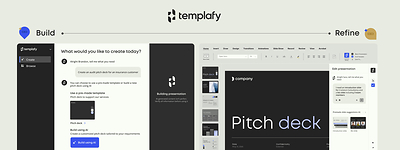
When asked about Templafy’s core products and features, Chanoine explained:
Templafy is an agentic document generation platform used by more than 4 million users worldwide to create high-quality enterprise documents that are accurate, compliant, and on-brand.
It combines AI with patented rules-based automation to generate business-ready documents using approved content, enterprise knowledge, and business data.
Rather than simply helping people generate text, our platform helps ensure proposals, contracts, presentations, reports, and other business-critical documents are created correctly the first time.
More recently, we’ve expanded that vision by supporting Model Context Protocol, or MCP, allowing AI assistants like ChatGPT, Claude, Copilot, and Gemini to connect directly into governed document workflows.
This gives organizations the flexibility to incorporate leading AI assistants into their existing document processes while maintaining consistency across the enterprise.
The Challenge Of Scaling Enterprise AI
When asked about recent challenges in the sector and how Templafy has addressed them, Chanoine explained:
One of the biggest challenges has been helping enterprises separate the excitement around AI from what it actually takes to deploy it successfully at scale.
The major AI providers have done an incredible job showcasing what’s possible, but those demonstrations don’t always reflect the realities of large organizations, where business processes are often far more complex than a simple prompt.
As someone who works closely with enterprise customers every day, I’ve seen that the conversation has shifted.
Organizations are no longer asking, “Can AI generate a document?”
They’re asking, “Can we trust the output enough to send it to a customer?”
That’s where Templafy has continued to differentiate itself.
Rather than trying to build the biggest model, we’ve stayed focused on what I call “practical AI,” combining AI with rules-based automation and enterprise knowledge to consistently produce documents that people can confidently use.
That specialized approach has allowed us to continue growing alongside, and often complementing, some of the largest AI companies in the world.
How Templafy’s Technology Has Evolved
When asked how Templafy’s technology has evolved since launching, Chanoine said:
Our mission has remained remarkably consistent: eliminate manual document work.
Initially, that meant helping organizations centrally manage and distribute content.
From there we added workflow automation and intelligent document assembly.
Today we’re combining those capabilities with AI so users can generate high-quality business documents with far less manual effort.
The common thread throughout our evolution has been reducing repetitive work while allowing employees to spend more time on strategic, customer-facing activities.
Key Company Milestones
When asked about Templafy’s most significant milestones, Chanoine highlighted the company’s customer retention:
One achievement we’re particularly proud of is maintaining customer retention rates consistently above 90% throughout our history.
Enterprise software only succeeds if customers continue seeing value year after year, regardless of changing technology cycles.
Maintaining that level of customer loyalty through cloud transformation, digital transformation, and now AI has been an important validation of both our platform and our long-term strategy.
Customer Success With ERM
When asked to share a specific customer success story, Chanoine pointed to Templafy’s work with ERM:
One example that stands out is our work with ERM, the world’s largest sustainability advisory firm.
As the company rolled out its first global rebrand in more than 40 years, it needed a way to ensure thousands of employees across dozens of countries could immediately access the latest templates, content, and brand assets without disrupting the way they already worked.
By embedding Templafy directly into Microsoft Word and PowerPoint, ERM gave more than 8,500 employees instant access to approved templates and brand assets inside the applications they use every day.
In the first year alone, employees created nearly 390,000 compliant documents, accessed approved brand assets more than 88,000 times, and saved approximately 63,000 working hours.
For me, what makes that success story compelling isn’t just the efficiency gains.
It’s that ERM was able to improve consistency and governance at a global scale while making the experience easier for employees.
That’s exactly the type of outcome we’re trying to deliver: helping organizations create business-critical documents faster without sacrificing quality or control.
Competitive Differentiation
When asked what differentiates Templafy from its competition, Chanoine said:
Our biggest differentiator is precision.
Many AI tools are optimized to generate content quickly.
We’re optimized to generate business-ready content correctly.
Templafy combines AI with rules-based automation, enterprise governance, and company-approved knowledge so organizations can consistently produce documents that meet their standards for branding, compliance, and quality.
We’re also model-agnostic.
Rather than forcing customers to bet on a single AI provider, we believe enterprises should have the flexibility to work with the models that make the most sense for their business, geography, and regulatory requirements.
Our recent support for MCP reflects that philosophy by allowing organizations to securely connect multiple leading AI assistants into governed document workflows.
Ultimately, we see ourselves as the control layer between AI and the final document.
Rather than simply generating text, we help enterprises ensure AI produces outputs they can actually trust.
Future Goals
When asked about Templafy’s future goals, Chanoine explained:
Our long-term vision remains the same: to eliminate manual document work.
As AI continues to mature, we want to make it possible for employees to move from an idea to a customer-ready document with minimal manual effort while still maintaining enterprise governance, quality, and brand standards.
We’re also committed to remaining model-agnostic.
AI will continue evolving rapidly, and we believe enterprises should have the flexibility to benefit from whichever models best meet their business, regulatory, and security requirements over time.
The Future Of Enterprise AI And Documents
When invited to discuss another topic, Chanoine highlighted the early stage of enterprise AI adoption and the continuing importance of documents:
We’re still in the very early stages of enterprise AI.
The technology is evolving incredibly quickly, and I don’t think anyone can say with certainty what the landscape will look like five years from now.
That’s one of the reasons we’re committed to remaining model-agnostic.
Rather than betting on any single AI provider, we want our customers to have the flexibility to adopt the models that best fit their business as the market continues to evolve.
One thing I do believe will remain constant is the importance of documents.
Every proposal, contract, presentation, audit report, or customer communication represents a critical business moment.
Regardless of how the underlying AI models evolve, eliminating the manual document work will mean organizations can create those documents faster, more accurately, and with greater confidence.
