Tricentis provides an end-to-end enterprise agentic quality engineering platform designed to help the world’s largest organizations scale software quality at the speed of AI while maintaining governance and human oversight. Its portfolio includes Tosca for test automation, qTest for test management and visibility, NeoLoad for performance testing, SeaLights for quality intelligence, and a growing set of AI agents coordinated through Tricentis AI Workspace. Pulse 2.0 interviewed Tricentis Chief Product Officer Eran Sher to learn more.
Eran Sher’s Background


When asked about his background, Sher shared:
I’ve spent my career building enterprise software platforms where quality, speed, and trust are inseparable, because when you’re serving global enterprises, software delivery is not an IT concern; it’s a business resilience concern.
Over the last 25+ years, I’ve led and built products in environments where complexity is the norm: large-scale systems, many teams, strict governance, and constant pressure to move faster without increasing risk. Most recently, I co-founded SeaLights and served as CEO, where we pioneered quality intelligence, connecting code change to test coverage and release risk, so organizations could focus effort where it matters most.
Tricentis acquired SeaLights in 2024. I joined as General Manager of Quality Intelligence and was later asked to take on the role of Chief Product Officer to lead product strategy across the entire portfolio and drive our next chapter of agentic quality engineering, turning innovation into enterprise-grade capabilities that customers can trust and operationalize at scale.
Earlier in my career, I co-founded Nolio, a DevOps automation company that was acquired by CA Technologies, and I held leadership roles at Mercury Interactive and other enterprise software firms. What ties these experiences together is a consistent focus on helping large organizations deliver change with confidence, turning quality from a bottleneck into a strategic advantage, especially now as AI and cloud are fundamentally reshaping how software is built and released.
Primary Responsibilities
When asked about his primary responsibilities, Sher explained:
As Chief Product Officer, my primary responsibility is to make sure our strategy and product execution stay anchored in enterprise outcomes: faster release cycles, lower operational risk, and measurable productivity gains. That means owning the full product portfolio and roadmap, and ensuring we deliver as a unified platform.
A major part of my role today is leading our next phase of agentic quality engineering. We’re moving beyond automating individual tasks toward orchestrating outcomes, where AI agents help plan, create, optimize, and learn across the testing lifecycle, with the governance and controls enterprises require.
Favorite Memory
When asked about his favorite memory working for Tricentis so far, Sher said:
I joined Tricentis in July 2024, following Tricentis’ acquisition of SeaLights. That moment stands out not only because an acquisition is a major milestone, but because of what it made possible at enterprise scale.
What has been most meaningful for me is seeing how quickly Tricentis can take innovation and make it real for the largest and most complex organizations in the world: fast, thoughtfully, and in a way that feels integrated rather than “bolted on.” SeaLights brought quality intelligence and change-based risk visibility. But the real power comes from combining that intelligence with a platform that enterprises already rely on: Tosca for end-to-end test automation, qTest for unified test management and visibility, and NeoLoad for performance and reliability at scale.
When you connect those capabilities, you’re not solving a narrow testing problem, you’re enabling confidence across the entire delivery lifecycle. And importantly, it applies across the enterprise stack: packaged applications and core systems, modern web and mobile, APIs and microservices, and increasingly hybrid and cloud environments. It’s one platform approach that supports quality across all application types, not a collection of disconnected tools.
In addition, the current AI boom is fueling even greater acceleration in both the pace and scope of change among the countless applications that comprise modern enterprise landscapes. Errors in even a single application can quickly cascade throughout an organization’s connected application ecosystem, increasing downtime, introducing risks, and derailing business objectives. Generic AI tools may appear smart and fast, but without a complete understanding of specific application context and critical end-to-end application connections, results can be unreliable and risky.
Over the past year, it’s been especially exciting to bring the first end-to-end enterprise agentic quality engineering platform to market. Leading a coordinated, cross-company push to bring practical AI solutions to enterprise customers, solutions designed for real complexity, with the governance, security, and trust requirements that large organizations demand, is what sets Tricentis apart in how we’re redefining the future of agentic quality engineering.
Since then, we’ve continued building on that vision, including through our acquisition of Tabnine and the launch of Tricentis Labs, an incubator for emerging AI innovation. Both are helping us advance enterprise agentic quality engineering by combining deeper enterprise context with new approaches to autonomous application exploration, AI agent evaluation, and release decision-making.
The collaboration across the company has been a real highlight: product, engineering, customer success, marketing, sales and field teams moving in one direction to translate AI innovation into measurable outcomes.
For me, that combination, innovation plus execution, delivered responsibly at enterprise scale, is the most rewarding part of the journey so far.
Core Products And Features

When asked about Tricentis’ core products and features, Sher detailed:
Tricentis provides an end-to-end enterprise agentic quality engineering platform designed to help the world’s largest organizations scale quality at the speed of AI with built-in governance and human oversight.
The Tricentis Agentic Quality Engineering Platform combines powerful AI agents with decades of Tricentis expertise and proprietary technology across nearly 200 ERPs and packaged applications, while also extending to web and custom apps to accelerate and scale software development and quality autonomously while human employees retain oversight, judgment, and accountability.
By orchestrating a team of intelligent AI agents, the platform empowers enterprise teams to deliver rapid innovation while managing risk and resources, fundamentally redefining how high-quality code can be tested, governed, and released, at the speed of AI.
AI is at the center of our strategy, and we are leading the market in terms of innovation. In June 2024, Tricentis was the first major quality engineering platform to deliver secure remote MCP servers, the “UI for AI” infrastructure that allows AI agents to interact directly with enterprise-grade testing tools like Tricentis solutions Tosca, NeoLoad, and qTest.
MCP enables customers and partners the flexibility to co-develop solutions with Tricentis or build their own, whether using Anthropic’s Claude AI assistant or third-party agents powered by OpenAI or platforms like Cursor. This supports a variety of critical use cases for high-quality software, and this open, modular framework ensures organizations can tailor their AI strategy to fit their unique software quality needs on their own terms and at their own pace.
At the same time, we introduced Tricentis Agentic Test Automation, which was the first AI agent capable of generating complete test cases from natural language prompts, analyzing prior test runs, and adapting to enterprise-specific context.
On March 10, 2026, we announced the launch of Tricentis AI Workspace along with a team of new AI agents. AI Workspace operates as a single, unified control plane with shared context, integrated workflows and native agent-to-agent collaboration to serve as the system of record for agentic quality engineering, coordinating AI agents across testing, automation, performance and quality intelligence, while embedding governance, approvals and auditability directly into execution.
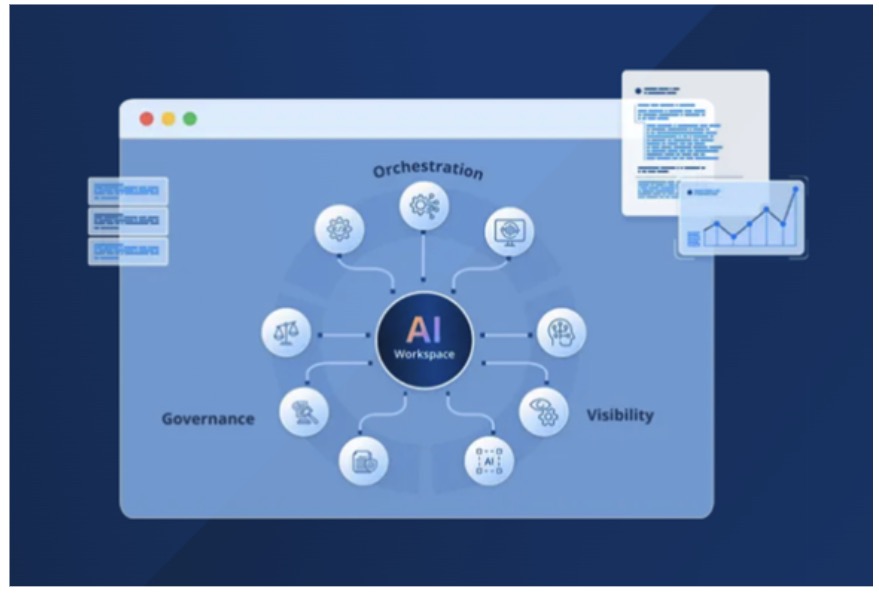
AI Workspace

Within Tricentis AI Workspace are several AI agents working together with defined responsibilities across the entire software development lifecycle (SDLC):
- Tricentis Agentic Quality Intelligence: Continuously interprets change, risk, and quality signals across the SDLC to determine release readiness, automatically directing testing and escalating to humans only when judgment is required.
- Tricentis Agentic Test Automation: Building on the initial launch of Agentic Test Automation, this next generation increases productivity. New features include support for SAP GUI and web applications, deeper integration with Tricentis Tosca automation engines, and intelligent reuse of test modules to reduce duplication, maintenance, and risk.
- Tricentis Agentic Performance Testing: Delivers enterprise-ready, AI-driven performance validation by embedding autonomous agents across analysis, design, and execution, accelerating insights by up to 90–95%, eliminating manual expert bottlenecks, and enabling faster, more confident AI-era release decisions from API to end-to-end systems.
- Tricentis Agentic Test Creation: Integrated deeply into Tricentis qTest, Agentic Test Creation lives side by side with test engineers, helping them with in-context test authoring. Enables natural-language test creation, allowing teams to generate reusable test cases faster and more consistently while reducing duplication and reliance on specialized expertise.
More recently, Tricentis acquired Tabnine to bring its Enterprise Context Engine into the Tricentis Agentic Quality Engineering Platform. The technology builds a continuously updated understanding of an organization’s software environment across code, documentation, tickets, APIs, infrastructure, and system dependencies. This deeper enterprise context will help quality and testing agents make more accurate decisions, identify risk, and operate effectively across complex environments.
Across the platform, our core features come together around a few outcomes that matter to enterprise leaders:
- End-to-end coverage across application types
We support quality workflows across packaged enterprise applications, custom applications, APIs and microservices, web and mobile, and hybrid cloud environments, because that is what real enterprise stacks look like.
- Platform-level visibility and governance
We help teams and executives understand quality in business terms: what is covered, what is at risk, what is ready to ship, and what needs attention, backed by traceability and controls that large organizations require.
- Enterprise agentic quality engineering
We are applying agentic AI across the quality lifecycle to help teams accelerate test creation, reduce maintenance, optimize execution, identify risk, and help teams make faster, more informed release decisions. The focus is practical AI that delivers outcomes in complex environments, with the governance,trust and human oversight enterprises need.

Building Enterprise Trust In AI
When asked about recent challenges in the sector and how Tricentis has addressed them, Sher explained:
Absolutely, and the biggest challenge this year has been trust at enterprise scale.
Many organizations are under intense pressure to adopt AI-driven tools quickly. At the same time, a lot of large enterprises have already been burned by inflated “AI” promises that didn’t translate into real value in production. In software testing, that credibility gap is even more sensitive.
The teams we work with are releasing faster than ever, and the software they ship sits at the core of their business, customer experience, revenue systems, regulated processes, and brand trust. They can’t afford to “blindly trust” an AI tool in the most risk-sensitive part of the lifecycle.
As a CPO, that creates a very specific bar: customers must see value from day one, and they must have confidence that AI is being applied responsibly, with the controls, transparency, and governance that enterprise environments demand.
How did we address it? By focusing on practical, enterprise-grade AI, not AI as a feature, but AI as a system that is measurable, explainable in its outcomes, and integrated into real workflows.
We’ve invested in GenAI and AI-augmented capabilities that accelerate creation, reduce maintenance, optimize execution, and improve decision-making, while still giving teams the ability to validate, govern, and control what happens.
The result is that customers don’t have to choose between speed and trust. They can modernize their quality engineering approach, improve team productivity, and release faster with confidence even as the market continues to scale and the pace of change keeps accelerating.
We believe independent validation matters here as well. Forrester recognized Tricentis in The Forrester Wave™: Autonomous Testing Platforms as “ideal for large enterprises seeking a one-stop shop for comprehensive testing, including AI-driven automation.”
And Gartner named Tricentis a Leader, positioned highest for Ability to Execute, in the first-ever Gartner® Magic Quadrant™ for AI-Augmented Software Testing Tools, noting that these tools are essential for businesses aiming to improve software quality, productivity, and market responsiveness.
That combination, enterprise urgency, high risk, and the need for immediate value, has been the core challenge. And it’s exactly where we’ve leaned in and delivered.
How The Technology Has Evolved
When asked how Tricentis’ technology has evolved since launching, Sher noted:
Tricentis has evolved from a strong foundation in enterprise test automation into a full quality engineering platform designed for the realities of modern enterprise IT, Cloud, DevOps, packaged apps, and highly regulated environments.
The platform has expanded in two major directions:
1) From tools to platform: We’ve brought together automation, management, performance, and quality intelligence so enterprises can run quality as a connected system, not as isolated teams and technologies.
2) From automation to agentic quality engineering: We’ve evolved beyond traditional automation and co-pilots to an agentic approach where agents can work across the quality lifecycle with enterprise context, governance and human oversight. AI Workspace, remote MCP servers and our growing portfolio of agents provide the foundation for this model, while our acquisition of Tabnine adds deeper enterprise context to help agents better understand the systems and dependencies of the software they are testing.
Key Company Milestones
When asked about some of Tricentis’ most significant milestones, Sher highlighted:
-
- Building a category-leading enterprise platform (since 2007): Tricentis was founded in 2007 and has grown into a global company serving the needs of large enterprises where software quality directly impacts revenue, operations, and customer trust.
- Reaching true enterprise scale: Today Tricentis serves 3,000+ customers and works with over 60% of the Fortune 500, which is a strong signal of trust in mission-critical environments.
- Sustained growth and strategic investment: A major milestone was the $1.33B investment by GTCR, valuing the company at $4.5B, a clear validation of both the market opportunity and Tricentis’ leadership position.
- Expanding the platform into Quality Intelligence with SeaLights (July 2024): The acquisition added SaaS-based quality intelligence, connecting code changes to test coverage and risk, and strengthened Tricentis’ ability to support modern CI/CD-driven organizations.
- Independent analyst recognition for the next era of testing: In 2025, Gartner named Tricentis a Leader in the first-ever Magic Quadrant for AI-Augmented Software Testing Tools and positioned Tricentis highest for Ability to Execute, a meaningful milestone as AI becomes central to software delivery.
- Validation of the autonomous testing direction: Forrester recognized Tricentis as a Leader in The Forrester Wave™: Autonomous Testing Platforms (Q4 2025), noting Tricentis as “ideal for large enterprises seeking a one-stop shop for comprehensive testing, including AI-driven automation.”
- Defining the shift to agentic quality engineering (2025–2026): Tricentis unveiled its Agentic Quality Engineering Platform and AI Workspace in October 2025, with AI Workspace reaching general availability in March 2026. The platform brings together purpose-built AI agents across the SDLC, with AI Workspace serving as the orchestration layer and providing the governance, visibility, and human oversight enterprises need to adopt agentic quality engineering at scale.
- Expanding our agentic AI vision (2026): Tricentis built on that foundation with the acquisition of Tabnine, bringing deeper enterprise context into the Tricentis Agentic Quality Engineering Platform, followed by the launch of Tricentis Labs and three new AI innovations: Tricentis Aida, Tricentis AgentScore, and Tricentis Release Risk Intelligence.
Customer Success Stories
When asked about specific customer success stories, Sher shared:
Partnering with our customers to make sure they deliver their business outcomes is a critical part of how we do business. We have a very vibrant community of customers participating in our beta and alpha programs.
Early results from Tricentis Agentic Test Automation users showed:
- 85% reduction in manual effort for test creation
- 60% boost to overall productivity
- And a significant reduction in operational costs by minimizing redundancies and focusing resources.
We also have many outstanding published stories from Duke Energy, Experian, VodafoneZiggo, and more.
Competitive Differentiation
When asked what differentiates Tricentis from its competition, Sher identified three areas:
At enterprise scale, differentiation comes down to outcomes: how fast customers can ship change, how confidently they can do it, and how well they can govern risk. Tricentis stands out for three reasons:
1) We deliver a unified enterprise platform, not a point tool.
Large organizations don’t have one app type or one team. They operate across packaged enterprise systems and custom software, and quality requires automation, management, performance validation, and intelligence working together. Our portfolio is built to cover the full quality lifecycle, end-to-end, so enterprises can standardize rather than stitch together tools.
2) We’re leading the shift to agentic quality engineering, with enterprise controls.
The market is moving quickly from “tests as scripts” to “quality as an intelligent, agentic system.” We’re building enterprise-ready AI agents that help teams create, optimize, and operate testing workflows faster, while meeting requirements for security, governance, and trust.
Our direction on agentic AI, including Remote MCP servers and Agentic Test Automation, reflects that focus on scalable, controlled AI in real enterprise environments.
3) Independent validation + enterprise adoption reinforces execution, not just vision.
Gartner named Tricentis a Leader in the first-ever Magic Quadrant for AI-Augmented Software Testing Tools, 2025 and positioned us highest for Ability to Execute, a strong signal that this isn’t theoretical; it’s working in practice.
Forrester also recognized Tricentis as ideal for large enterprises seeking a “one-stop shop” for comprehensive testing, including AI-driven automation.
And at scale, we work with 3,000+ customers and over 60% of the Fortune 500, which reflects deep trust in mission-critical environments.
Future Goals
When discussing Tricentis’ future goals, Sher concluded:
Based on where the market is heading, large enterprises are about to face a more complicated reality, not a simpler one: AI is rapidly increasing the volume of change, the number of tools teams adopt, and the speed the business expects from software, while risk tolerance in production is staying the same or getting stricter.
Gartner has said that by 2028, 75% of enterprise software engineers will use AI code assistants, up from less than 10% in early 2023, and that scale shift will fundamentally increase release velocity and the surface area that must be validated.
At the same time, analysts are clear that “AI” in testing can’t be a thin layer of marketing; it has to become an operational capability that enterprises can trust. Gartner notes that AI-augmented testing tools are intended to be more than authoring and execution, and are essential for businesses aiming to achieve excellence in software quality, productivity, and market responsiveness.
Forrester is pointing in the same direction: autonomous testing platforms are emerging because many organizations plateaued with traditional automation, and the next step requires GenAI and intelligent agents that are adaptive and risk-aware.
Against that backdrop, our goal is to keep advancing agentic quality engineering, where specialized agents can operate across the SDLC with the enterprise context, governance, and human oversight required to make increasingly autonomous decisions. We’re also exploring what comes next through Tricentis Labs, where we can work directly with customers and partners to put emerging technologies to the test against real-world enterprise needs. Recent AI innovations include:
- Tricentis Aida – autonomously explores applications to surface defects and coverage gaps without requiring an existing test suite.
- Tricentis AgentScore – evaluates AI agents in real-world workflows and generates quality scores to help determine production readiness.
- Tricentis Release Risk Intelligence – identifies and prioritizes release risks and coverage gaps to help teams make faster, more informed release decisions.
Together, these innovations offer a glimpse into where we see agentic quality engineering heading next, helping enterprises move at the speed AI makes possible without sacrificing the quality, trust, and control their businesses depend on.

