

VeryAI is on a mission to make the internet more human, all in the palm of your hand. They use a smartphone-only palm scan to verify real human users and their authorized AI agents from bots. Pulse 2.0 interviewed VeryAI founder and CEO Zach Meltzer to learn more.
Zach Meltzer’s Background

Could you tell me more about your background? Meltzer said:
Before starting VeryAI, I led growth at Galxe, helping scale one of the largest loyalty and distribution platforms in crypto to more than 6,000 partners and 34 million users. I joined in 2022 with the belief that building on-chain reputation would become an integral layer for digital identity and trust online.
My interest in crypto began in high school when I bought my first Bitcoin in 2018. While in college, I joined a startup consulting firm when it was just four people sitting around a dining room table. That company eventually grew to more than 300 employees and returned over $7 billion to clients, giving me an early look at what it takes to scale a business.
Toward the end of college, I decided to pursue crypto full-time and eventually joined Galxe just days before the collapse of FTX. Over the next several years, I worked closely with many of the industry’s leading companies, including Coinbase, Binance, and thousands of others. Those experiences deepened my understanding of digital identity, its shortcomings, and ultimately led to the founding of VeryAI.
Today, our conviction is simple: as AI agents, bots, and synthetic content become increasingly common, proving that a real human is behind an account, action, or transaction will become one of the internet’s most important challenges.
Formation Of The Company
Every day, the internet feels less human.
AI, bots, and deepfakes are making it harder to know who or what is real.@VeryAI was born to solve that.Today, I’m excited to share that we’ve raised $10M to build the first Proof of Reality for the new internet. ↓ pic.twitter.com/anVl2DCpqi
— meltz (@itszach) March 12, 2026
How did the idea for the company come together? Meltzer shared:
During my time at Galxe, the company evolved into a powerful distribution network and facilitated hundreds of millions of dollars in value for its users. However, this success also attracted significant sybil and bot attacks. To address these challenges, we developed solutions such as a zero-knowledge KYC, reputation scoring, and a zero-knowledge protocol. Despite these efforts, we fell short of delivering a solution that was both comprehensive and user-friendly.
I quickly recognized a gap between what our partners needed and what we could offer. This was not just a Galxe problem. It reflected a broader shift across the industry ,and the world, where most platforms struggled to keep up with the growing demands around identity.
That realization, along with my frustration with the lack of effective solutions, led me to search for alternatives and ultimately start VeryAI.
Favorite Memory
What has been your favorite memory working for the company so far? Meltzer reflected:
In the first few months of Very, when it was just our engineering team and me, I had stayed up all night essentially thinking of everything that could go wrong: our competitors were already too big, regulation and compliance would be too difficult to navigate, the market was too early, we wouldn’t be able to raise capital…The next day, Sora 2 by OpenAI launched. It marked a major milestone in image and video generation and reinforced my belief that, despite the difficulty, differentiating between humans and AI was one of the most important problems to tackle in our lifetime. Since then, dozens of hyperrealistic image and video generation tools that allow people to create synthetic personas have emerged. As a sign of how quickly the space is evolving, Sora 2 itself was shut down less than a year later.
Core Products
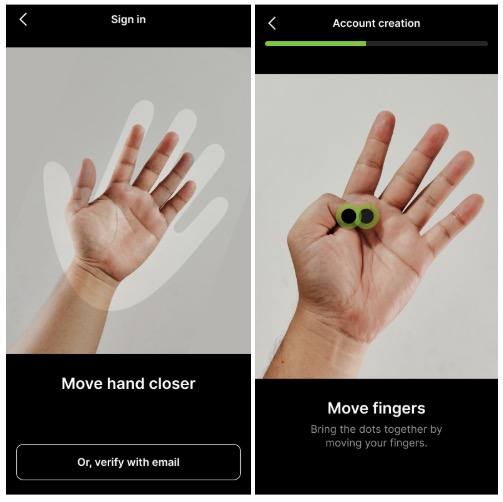
What are the company’s core products and features? Meltzer explained:
Our core product is a palm scan that works on any standard smartphone camera, no external hardware required. It confirms that a real, unique person is on the other end of any interaction. There are over 10 patents across liveness, uniqueness and matching on the technology.
Unlike other biometrics, our palm scan scores highly across accuracy, scalability, and privacy:
– Accuracy – Palm biometrics provide superior uniqueness compared to facial recognition and fingerprints. VeryAI’s proprietary palm recognition system achieves a false acceptance rate of less than 1 in 10 million, exceeding the publicly reported performance of Apple Face ID (1 in 1 million).
– Scalability – Unlike fingerprints, which require dedicated hardware, or iris recognition, which depends on specialized infrared cameras, palm biometrics work with standard smartphone cameras. This enables global deployment without additional hardware, making human verification accessible to billions of users.
– Privacy – VeryAI is a self-sovereign, pseudonymous identity system designed to prove a person is unique without revealing who they are. Users remain in control of their accounts and can permanently delete it and associated biometric data at any time.
Challenges Faced
Have you faced any challenges in your sector of work recently? Meltzer acknowledged:
Biometrics and authentication are not easy verticals to build in. Every company in this space faces the challenge of earning user trust. Over time, people have become wiser about sharing personal information online, and for good reason. As a result, building trust is one of our biggest priorities.
The second challenge is education. When you say fingerprint or iris, most people immediately understand that you’re talking about biometrics. The same is not yet true for palm. We need to educate users on what palm biometrics are, how they work, and why they offer a better experience than existing methods.
Evolution Of The Company’s Technology
How has the company’s technology evolved since launching? Meltzer noted:
VeryAI has expanded beyond just biometrics into a new product: AG9.
AG9 is VeryAI’s layer for AI agent accountability. It delivers cryptographic proof that a verified human owns a given agent and approves a specific action in three steps:
1) Human Verification: The user opens VeryAI, scans the agent’s pairing QR, reviews the permitted scope, and palm-scans to confirm. The agent is cryptographically linked to a verified human identity.
2) Link Agent: When a sensitive action is triggered, the partner platform pings AG9 for approval. The user receives a prompt and palm-scans to authorize or deny the action. The agent is issued a signed JWT attestation containing the human_id, scope, and hash of the approved action. AG9 attestations verify in under 100ms with no SDK required.
3) Approve Actions: When the agent calls a partner API or visits a platform, it presents its AG9 attestation. The platform verifies the signature and confirms the action is human-authorized. It can then grant efficient API access instead of forcing agents through CAPTCHA-gated browser flows.
If a linked agent behaves maliciously, platforms can revoke its AG9 attestation and escalate to the verified human behind it.
We’re already working with Moonpay, Rentahuman, SaharaAI, SorinAI, and others on the product.
Funding/Revenue
Are you able to discuss funding and/or revenue metrics? Meltzer revealed:
We’ve raised $10 million in seed funding. Our investors include Polychain Capital, Berggruen Holdings, Anagram, and strategic angels like Anatoly Yakovenko, co-founder of Solana. We’re using that capital to further build out the team and expand the product offering. We’re not disclosing valuation or revenue figures at this time.
Total Addressable Market
What total addressable market (TAM) size is the company pursuing? Meltzer assessed:
VeryAI sits at the intersection of two massive, converging markets. The biometric identity market is projected to exceed $80 billion by 2030. The AI agent infrastructure market is nascent but accelerating: major AI labs are shipping agent frameworks (OpenAI, Anthropic, Google), enterprises are beginning large-scale agent deployments, and regulators worldwide are signaling that AI accountability requirements are imminent. Identity-related financial fraud also exceeds $12 billion annually.
Differentiation From The Competition
What differentiates the company from its competition? Meltzer affirmed:
A few things set us apart from others in the space. First, we’re software-only, with no special hardware terminals and no device rollout costs. Our palm scan runs on the cameras people already carry, so platforms can verify real users at any key moment without asking them to invest in new devices.
The palm itself is a more secure biometric. Your face is frequently shared online in photos and videos, which makes it easier to copy or spoof. Your palm isn’t publicly exposed in the same way and isn’t inherently linked to your identity the way your face is, which lowers risk if data is ever compromised. And with a false acceptance rate of one in 100 trillion with dual palm scanning, the accuracy is simply in a different category from what traditional companies offer.
We’re built specifically for the AI world we now live in. Legacy identity checks like CAPTCHA and two-factor logins are increasingly easy for bots and deepfakes to bypass. VeryAI only requires a smartphone to confirm a real, unique person, so platforms catch malicious attempts without adding friction for real users.
Future Company Goals
What are some of the company’s future goals? Meltzer concluded:
Our immediate focus is on delivering the best possible user experience, continuing to refine accuracy, speed, and expand partner integrations across social platforms, fintech, gaming, and other industries. We also plan to roll out additional verification products that tackle the rise in bots infiltrating daily life and privacy.
Expanding into KYA represents an important next chapter, as AI agents become a bigger part of how the internet operates, platforms will need a reliable way to verify who controls them.
