

Vikk AI is an AI-powered legal platform that helps consumers understand legal issues, work with legal documents, and determine when professional legal help may be appropriate. The company is also building a Lawyer Ad Center, Lawyer Directory, and Vikk Data Hub, which is intended to surface anonymized patterns across consumer legal interactions and provide earlier insight into emerging legal risks. Pulse 2.0 interviewed Vikk AI Co-Founder and CEO Walid Romaya to learn more.
Walid Romaya’s Background

When asked about his background, Romaya shared:
I came into software from a career in real estate development.
They may seem like very different businesses, but there are actually a lot of similarities. In both, you start with an idea, think about design and the user experience, work through a lot of details, coordinate different teams, and ultimately launch something that people are going to use.
What really attracted me to software was the ability to scale. In real estate, you are working with a finite resource: land. With software, if you build the right product, the ability to scale is almost unlimited.
I also became very interested in industries that still operate with legacy systems or have not fully digitized. Those industries are especially interesting now because AI can change the way people interact with them very quickly.
Legal was a natural fit for that. People often deal with legal issues at some of the most vulnerable times in their lives. If you can give them better information and help them understand their options, you empower them to make better decisions.
I also believe more informed consumers ultimately make the legal industry better. They understand their choices, ask better questions and know when they really need professional help.
That thinking played a big role in why we built Vikk.
How Vikk AI Started
When asked how the idea for the company came together, Romaya explained:
One of the big questions we had at the beginning was: Will people actually trust AI enough to discuss a legal problem with it?
At the time, that was not an obvious answer.
Legal issues are personal. They can involve your family, your job, your finances, your home or an injury. We believed AI could make that first legal interaction much easier, but consumers still had to be willing to use it.
I think that question has now largely been answered.
People have become much more comfortable using AI as a tool and as an aid. They use it to understand information, think through problems, organize their thoughts and explore different options.
That is exactly where we saw the opportunity in legal.
A person may know they have a problem, but they often don’t know what kind of legal problem it is, what their rights may be, whether it is serious, or whether they even need a lawyer.
Instead of expecting the consumer to understand the legal system first, we wanted them to simply tell Vikk what happened in their own words.
That was the beginning.
As the product evolved, we realized the opportunity was much bigger. Vikk could help people understand their situation, work with legal documents and connect with a lawyer when that made sense.
Then we started looking at the conversations collectively and realized there was another layer. If you responsibly anonymize those interactions and look at them at scale, you can begin to see legal patterns and risks before they show up in traditional legal data.
That eventually led to the Vikk Data Hub.
AWS And Meta Validation
When asked about his favorite memory working for the company so far, Romaya recalled:
One of my favorite moments was being selected for the AWS Startups: Build with Llama program with Meta.
More than 1,000 startups applied, and Vikk was one of 30 selected for the program. We received technical mentorship from AWS and Meta, access to other AI founders and up to $200,000 in AWS promotional credits.
For me, what made that meaningful was the validation.
When you are building something new, especially in a fast-moving area like AI, you spend a lot of time asking yourself whether you are seeing the opportunity correctly. Having companies like AWS and Meta look at what we were building and want to support it was a great moment for the team.
Core Products And Features
When asked about the company’s core products and features, Romaya detailed:
I think of Vikk today as having three main parts.
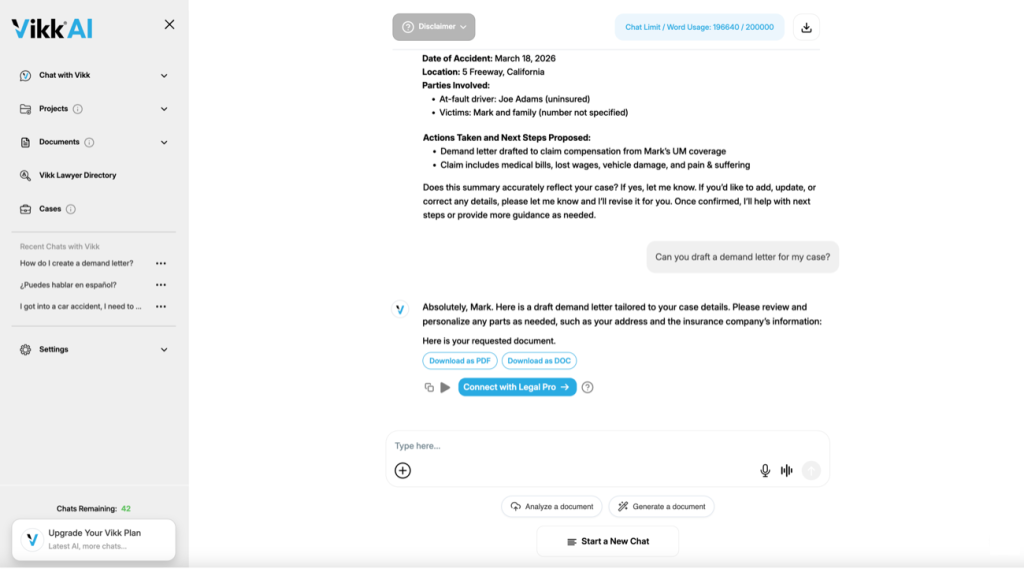
The first is the consumer experience.
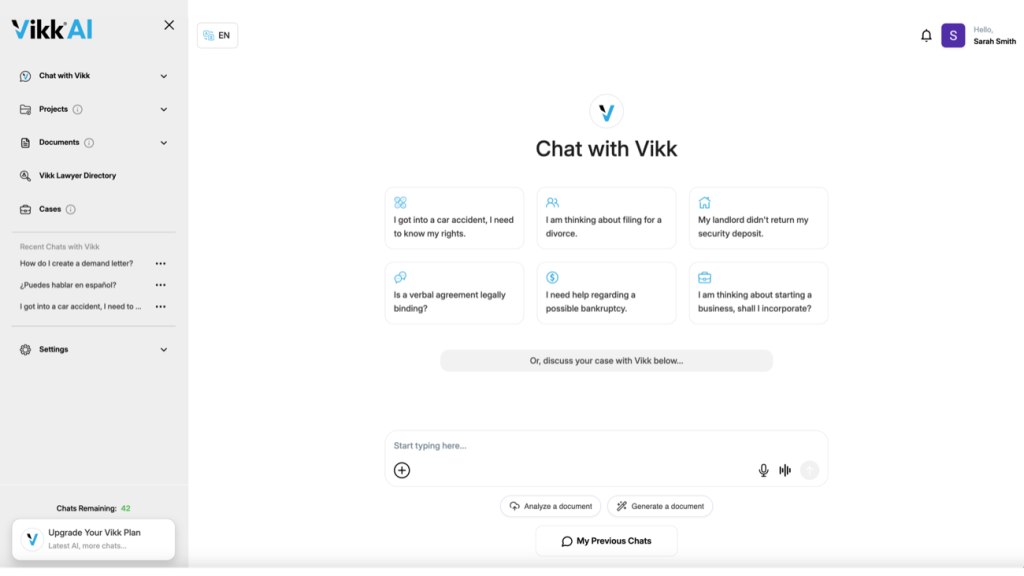
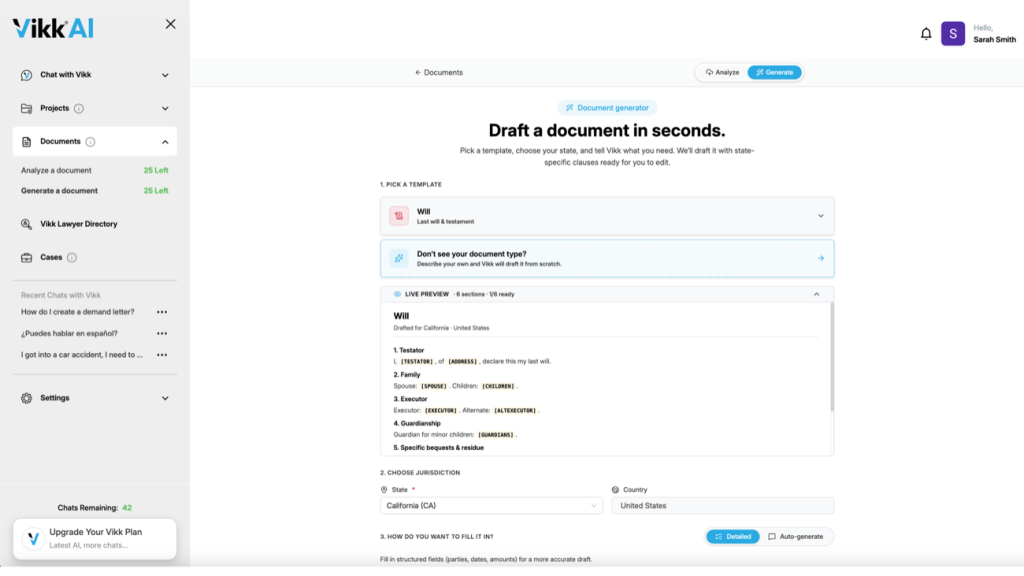
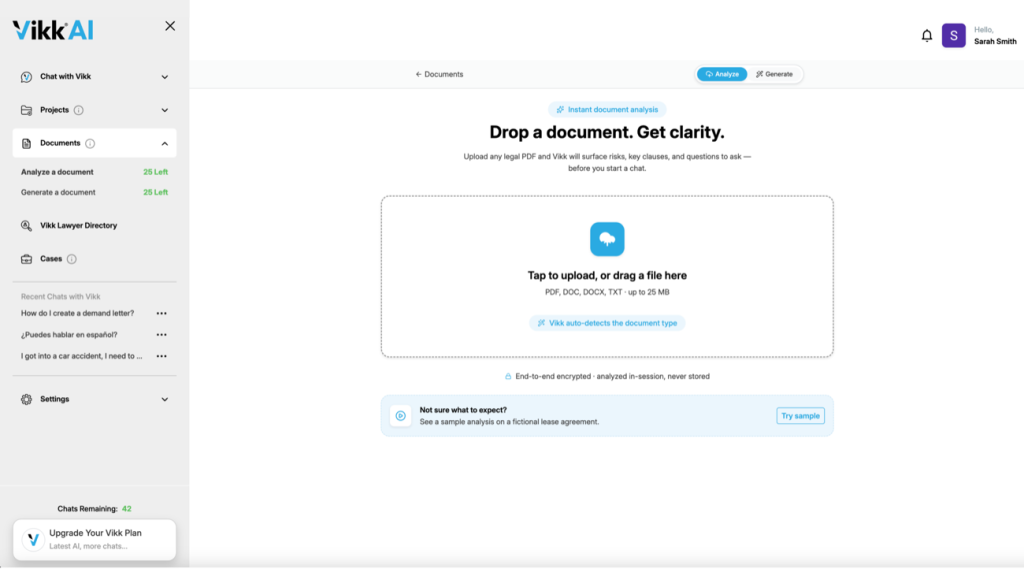
A consumer can come to Vikk with a legal issue and have a conversation about it. They can ask follow-up questions, upload and analyze documents, generate certain documents and interact with Vikk by text or voice.
The idea is to make that first legal step much easier.
The second part is lawyer discovery and advertising.
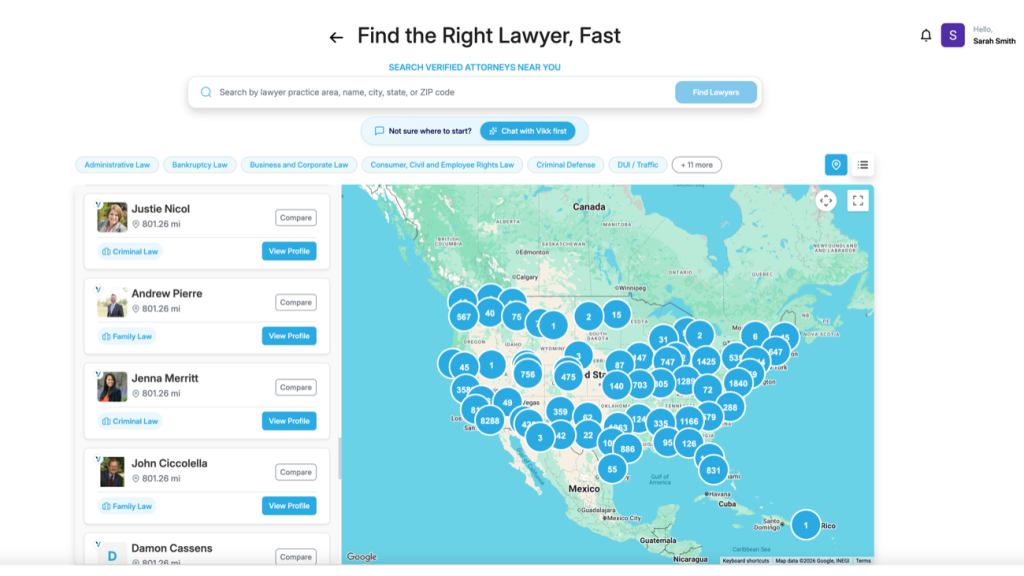
If a consumer reaches the point where they may need professional help, Vikk can help them discover lawyers who are relevant to the issue. We are building the Lawyer Ad Center and Lawyer Directory around that experience.
The third part is the Vikk Data Hub.
As more consumers use Vikk, we can begin to look at anonymized patterns across those legal conversations. What are people asking about? Where are certain problems increasing? Are we beginning to see a new legal issue emerge?
That kind of information could be valuable to insurers, banks, manufacturers, pharmaceutical companies, law firms and many other organizations that want to understand legal risk earlier.
Building Consumer Trust In AI
When asked about challenges in the company’s sector and how Vikk has addressed them, Romaya noted:
The first challenge was trust.
When we started, we didn’t know whether consumers would be comfortable talking to AI about something as important as a legal problem.
What we’ve seen is a major change in behavior. People now understand AI much more naturally as a tool that can help them understand complicated subjects.
That doesn’t mean AI replaces lawyers. That has never been our position.
Sometimes Vikk may help someone realize they can handle something themselves. Other times, it may help them understand that the issue is serious and that they should speak with an attorney.
Either way, they are making that decision with more knowledge.
The other challenge is the speed of AI itself.
I sometimes say that if the AI revolution were a 24-hour day, we’re probably at minute 30.
We’ve barely scratched the surface.
The models are going to get much better, and the capabilities we think are impressive today may seem fairly basic a few years from now.
So our goal is not to build Vikk around one model or one feature. We want to build the consumer relationship, the legal workflows, the lawyer ecosystem and the data around it so the company becomes more valuable as AI gets better.
Technology Evolution
When asked how the company’s technology has evolved since launching, Romaya explained:
Vikk started mainly as a conversational legal assistant.
You could explain a legal problem and have an ongoing conversation about it.
Since then, we’ve added much more around that experience.
Vikk now provides jurisdiction-specific legal assistance across the country. We’ve added document upload and analysis, document generation, voice interaction, better organization of legal matters and deeper lawyer discovery.
But probably the biggest change in our thinking came from the data.
At some point, you realize that if you are handling enough legal conversations, you’re not just answering individual questions anymore.
You’re beginning to see patterns.
You can see what people are worried about, what types of issues are increasing and where certain legal problems may be emerging.
That changed how we looked at the company.
We went from thinking about Vikk primarily as a consumer legal assistant to thinking about it as a much broader legal intelligence platform.
Major Company Milestones
When asked about some of the company’s most significant milestones, Romaya said:
The biggest milestone for me has been seeing real consumer adoption.
Vikk has now grown to more than 130,000 users across all 50 states, and we’ve handled more than 150,000 unique legal sessions or matters.
That tells us people are willing to use AI as part of their legal journey.
Being selected for the AWS and Meta Llama startup program was another important milestone. We were selected from more than 1,000 applicants and gained access to technical support, mentorship and AWS resources.
We’ve also expanded the product well beyond basic legal Q&A. We now have voice, document analysis, document generation, lawyer discovery and advertising.
And probably the biggest strategic milestone has been moving the Vikk Data Hub from an idea into a real product direction.
That takes the company from helping one consumer with one problem to asking a much bigger question: what can hundreds of thousands, and eventually millions, of anonymized legal interactions tell us about what is happening in the legal market?
Consumer Success Stories
When asked to share specific customer success stories, Romaya explained:
Because legal issues can be very personal, we are careful about sharing identifiable user stories.
But we see the same type of experience over and over again.
Someone comes to Vikk because something has happened and they don’t really know what to do next.
It could be a landlord issue, something at work, a family matter, an injury, debt, a contract or a legal document they don’t understand.
Within a few minutes, they can start understanding the issue, ask follow-up questions and get a better sense of their options.
Sometimes the answer is that the issue is relatively simple and they may be able to handle the next step themselves.
Other times, Vikk helps them understand that the matter is more serious and that speaking with a lawyer is probably the right next step.
To me, both are success stories.
The goal is not to push everyone toward a lawyer. The goal is to help people make a better decision.
Funding And Business Model
When asked about funding and revenue metrics, Romaya shared:
Yes. We’ve raised $4.2 million in total financing, made up of a $700,000 pre-seed round and a $3.5 million seed round.
That capital is helping us expand the consumer product, scale the Lawyer Ad Center and Lawyer Directory, continue building our document and agentic capabilities, and accelerate development of the Vikk Data Hub.
We are not publicly disclosing detailed revenue figures at this point.
Our business model is designed around several revenue streams: consumer subscriptions, lawyer advertising and discovery, and eventually enterprise subscriptions and data products through the Vikk Data Hub.
Expanding The Legal Market
When discussing the total addressable market Vikk is pursuing, Romaya explained:
The U.S. legal industry is a $400 billion-plus market, spread across large firms, midsize firms, small-law practices and corporate legal departments. Small law alone is roughly a $100 billion market.
But I think there is a much more interesting question.
How does the legal industry measure its market today?
Mostly through things like attorney billings, engagements, settlements and case outcomes.
In other words, it measures legal matters that made it into the legal system.
But what about all the legal problems that never reached a lawyer?
That is the blue ocean.
Maybe someone has an employment problem and doesn’t know whether it is really a legal issue. A tenant has a dispute with a landlord. Someone has a contract question, a debt issue, a family problem or something involving a product they purchased.
Historically, a lot of those people simply did nothing.
The cost was too high. They didn’t know where to start. Or they weren’t sure the problem was important enough to call a lawyer.
How do you measure that market?
You really can’t using traditional legal-industry data.
AI changes that because it dramatically lowers the friction of the first legal interaction.
A consumer can explain the problem, understand the context, explore their options and decide whether they need to take the issue further.
So I don’t think AI is simply taking a piece of the existing legal TAM.
I think AI is creating a new TAM around legal needs that were never measured or monetized before.
Over time, that new consumer legal market could potentially become as large as the traditional consumer legal market itself.
And for Vikk, there are additional markets around lawyer advertising and enterprise legal intelligence through the Vikk Data Hub.
So we’re not just thinking about how much of today’s legal market we can capture.
We’re thinking about how AI can expand the legal market itself.
Competitive Differentiation
When asked what differentiates Vikk from its competition, Romaya emphasized:
The biggest difference is that we’re not trying to build another legal chatbot.
We’re trying to build an ecosystem.
Someone can come to Vikk before they even know whether they have a legal matter.
They don’t have to know what practice area it belongs to. They don’t have to know what type of lawyer they need. They may not even know whether they need a lawyer.
That puts Vikk very early in the legal journey.
We can help the consumer understand the problem, work through documents and figure out possible next steps.
If they need a lawyer, we can help with that too.
But the really interesting part happens as all of those interactions start to add up.
Traditional legal databases mostly tell you what already happened.
A lawsuit was filed. A court issued an opinion. A settlement happened. A judgment was entered.
Vikk sees something much earlier.
We see what people are worried about before many of those problems ever make it to a courthouse.
That pre-lawyer, pre-adjudication data is very hard to recreate because you can’t simply scrape it from somewhere. It comes from the actual consumer interaction.
More consumers create more signals. More signals improve the intelligence. Better intelligence makes the platform more useful.
That’s the loop we’re trying to build.
Future Goals
When discussing the company’s future goals, Romaya said:
The big goal is to make Vikk a national legal hub.
We want it to become the place people think of going before they take almost any legal action.
That means Vikk has to become much more than question-and-answer.
It should increasingly help people understand documents, organize their matters, gather information, prepare materials, think through their options and take the next step.
We also want to significantly grow the lawyer side of the network and build an advertising and discovery model that fits the way people are going to search for professional services in an AI-first world.
And then there is the Vikk Data Hub.
We want to turn the anonymized signals coming from consumer legal activity into useful predictive intelligence for businesses.
We’re still very early.
Again, if AI is a 24-hour day, I think we’re somewhere around minute 30.
A lot of what is coming hasn’t even been invented yet.
Our goal is to build Vikk in a way that allows us to keep taking advantage of those advances as they happen.
Predictive Legal Intelligence
When invited to discuss another topic, Romaya concluded:
One area I’m particularly excited about is the shift from reactive legal information to predictive legal intelligence.
Most legal data today is backward-looking.
A case was filed. A court ruled. A settlement happened. A regulation changed.
Those are useful signals, but they are late signals.
The actual legal problem usually started much earlier.
It started when employees began asking similar questions about something happening at work.
Or consumers started reporting the same problem with a product.
Or tenants in a particular area started asking the same type of question.
Or people began seeing the same issue with a financial service.
Vikk sits very early in that process.
If we can responsibly anonymize and aggregate those signals, we may be able to see certain legal risks before they become obvious through lawsuits and court filings.
That’s the idea behind the Vikk Data Hub.
Imagine being an insurer, manufacturer, pharmaceutical company, bank or other enterprise and being able to see a legal-risk pattern developing before it becomes a major litigation trend.
That’s a very different use of legal data.
Vikk starts by helping one person understand one problem.
But at scale, those same interactions may help organizations understand what could be coming next.
