

Volteum is a fleet management platform built for electric and mixed vehicle fleets, giving operators a unified view of vehicle performance, charging, maintenance, costs, and electrification planning. The company connects directly to vehicle manufacturer data, eliminating the need for aftermarket hardware and letting fleets onboard without installation downtime. Its platform draws on more than 3 billion operational fleet data points to support capabilities including predictive maintenance, charging management, vehicle-level cost reporting, and electrification recommendations. Pulse 2.0 interviewed Volteum Co-Founder and CEO Zsófia Tóth to learn more about the company’s origins, technology, customer deployments, and vision for the future of fleet operations.
Zsófia Tóth’s Background
When asked about her background, Tóth shared:
I have a technical background and have spent most of my career working at the intersection of energy, mobility, and technology. Before co-founding Volteum, I worked in the energy sector, including at one of Central Europe’s largest energy companies.
I have a master’s degree in nuclear physics and have always been interested in how complex systems can be made more efficient through data and technology.
My Volteum co-founders and I have known each other for more than a decade. We met while studying at the Budapest University of Technology and Economics and later worked together in student organizations focused on energy and mobility.
After university, we pursued careers across companies including MVM Group, E.ON, Deloitte, and McKinsey, but stayed closely connected.
Our shared experience in energy and mobility gave us a front-row seat to one of the biggest industrial transitions underway today: the electrification of transport.
That ultimately led us to found Volteum. What started as a side project helping EV drivers evolved into a much larger opportunity to help fleet operators manage the complexity of mixed and electric fleets.
We launched Volteum full-time in 2022 after being accepted into Techstars and have been focused ever since on building the software infrastructure that helps fleets operate more efficiently as they navigate the transition to electrification.

How Volteum Started
When asked how the idea for Volteum came together, Tóth explained:
The idea for Volteum came from our own experience as electric vehicle drivers. In 2020, as we developed the first product meant to help EV drivers, we started receiving inbound interest from fleet operators who were facing the same issues, but at a much larger scale.
That led to an important realization: while individual electric vehicles faced inconveniences, fleet operators were dealing with operational challenges that could affect hundreds or thousands of vehicles and drivers.
At the same time, we saw that the fleet management software available on the market had largely been built for a diesel-only world and was struggling to keep pace with electrification.
As we worked with early customers, we discovered that the real challenge was not simply helping organizations switch to electric vehicles.
It was helping them manage increasingly complex mixed fleets containing electric, petrol, diesel, and hybrid vehicles while maintaining visibility over costs, maintenance, charging, and vehicle health.
That insight ultimately led us to pivot from a consumer product to a B2B platform, giving fleet operators the operational intelligence needed to manage fleets more efficiently as the industry transitions toward electrification.
Favorite Memory
When asked about her favorite memory working for the company so far, Tóth recalled:
One memory that stands out is our time in Torino during the Techstars program.
It was one of the first moments where the four of us were truly working on Volteum together full-time, away from our previous careers and fully committed to building something new.
Being somewhere unfamiliar, alongside other founders going through the same intensity, creates an energy that is hard to replicate.
I remember late nights working through our product positioning and long dinners with other Techstars founders where we would debate everything from business models to the future of mobility.
It reminded me of why we started, and gave us the conviction we needed to keep going.
Core Products And Features
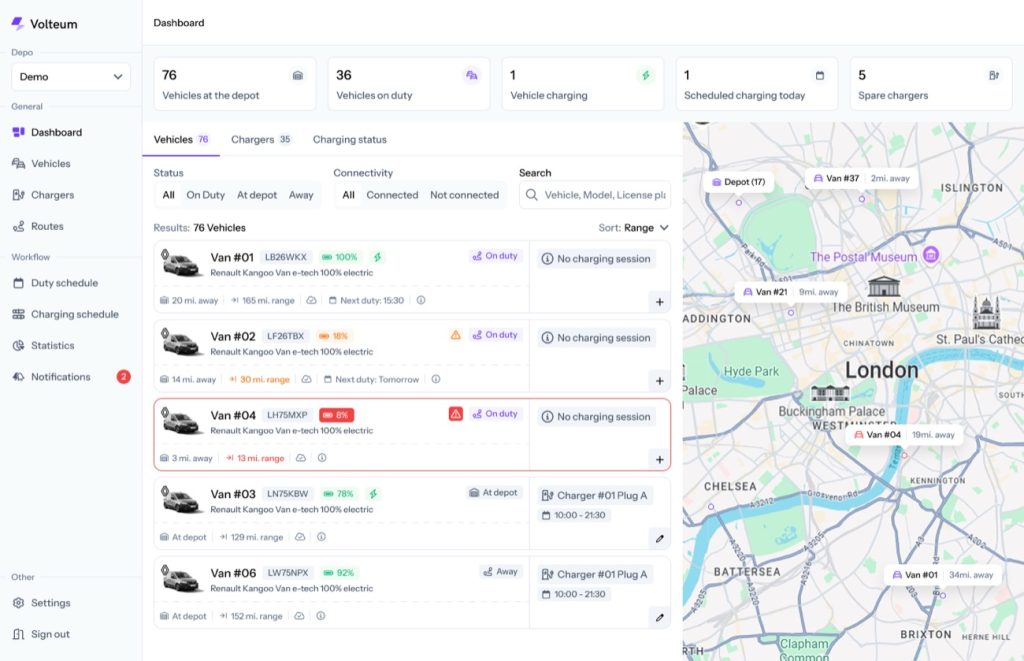
When asked about Volteum’s core products and features, Tóth detailed:
Volteum is a fleet management platform built for electric and mixed fleets.
Our core value proposition is simple: we bring all fleet data into one platform, giving operators real-time visibility into overall fleet performance without requiring any hardware installation.
One of our key differentiators is precisely this hardware-free OEM connectivity. Rather than relying on aftermarket telematics devices, we connect directly to vehicle manufacturer data sources, allowing fleets to go live in as little as 48 hours with no downtime or installation costs.
The platform’s core capabilities include fleet-wide vehicle monitoring, charging cost management, automated home charging reimbursement, fault detection, predictive maintenance, vehicle-level cost reporting, and fleet task management.
By consolidating data that is often spread across multiple systems, Volteum helps fleet managers reduce manual administration, identify operational issues earlier, and make more informed decisions.
In addition to day-to-day operations, we also offer fleet electrification planning through our Electric Fleet Planner workflow.
This helps fleets evaluate which vehicles are suitable for electrification, compare total cost of ownership scenarios, and plan charging infrastructure investments using real operational data.
Together, these capabilities enable fleet operators to manage today’s mixed fleets while preparing for the continued transition to electric vehicles.
Navigating Fleet Data And EV Market Challenges
When asked about challenges in the sector and how Volteum has addressed them, Tóth explained:
One of the persistent challenges in our sector is data fragmentation.
Fleet operators are managing vehicles from dozens of different manufacturers, each with their own connectivity protocols and APIs.
Getting consistent, reliable data across a mixed fleet of EVs and ICE vehicles is genuinely hard, and building the integrations to make that seamless requires significant technical investment.
We have tackled this through direct OEM partnerships and certified integrations, which is now one of our key competitive advantages, but earning the trust of vehicle manufacturers takes time.
A second challenge is the pace of the EV market itself. Government policies, incentives, and infrastructure rollouts change quickly, and fleet operators are trying to make long-term capital decisions in an uncertain environment.
Our response has been to build tools that help fleets model multiple scenarios rather than prescribing a single electrification path, so they can adapt as the landscape evolves.
A third challenge is organizational. The electrification of a fleet touches procurement, finance, operations, and sustainability teams simultaneously.
Volteum often sits at the intersection of all of them. Helping customers navigate internal alignment, not just the technology, has become an important part of how we deliver value.
How The Technology Has Evolved
When asked how Volteum’s technology has evolved since launching, Tóth said:
When we first built Volteum, the core focus was on helping fleet operators understand which vehicles in their fleet were suitable for electrification, essentially the planning problem.
Over time, as we worked more closely with customers who had already begun their transition, it became clear that the daily operations challenge was equally important and underserved.
That insight led us to build a much more comprehensive operational platform.
We expanded from electrification planning into real-time fleet monitoring, charging cost management, automated home charging reimbursement, predictive maintenance, and vehicle-level cost reporting.
More recently, we shifted from treating these as separate products to a unified platform: all your fleet data in one place.
One of the most significant technical decisions we made early on was to pursue hardware-free OEM connectivity rather than relying on aftermarket telematics devices.
This was harder to build but has proven to be a genuine differentiator: no installation costs, no vehicle downtime, and a much cleaner data layer.
Our platform now draws on more than three billion operational fleet data points, which feeds the intelligence layer across everything from fault detection to electrification recommendations.
As that dataset grows, the platform’s recommendations improve, creating a compounding advantage over time.
Key Company Milestones
When asked about some of Volteum’s most significant milestones, Tóth highlighted:
Volteum has achieved a number of important milestones since the company was founded in 2022.
One of the earliest was, as I mentioned earlier, our acceptance into the Techstars accelerator program, which helped validate the opportunity and marked the point at which our founding team committed to building the company full-time.
Another major milestone was our pivot from a consumer EV application to a B2B fleet management platform, driven by customer demand and which ultimately positioned us to address a much larger market opportunity.
On the commercial side, we have been fortunate to earn the trust of leading organizations including Royal Mail, Bolt, Lex Autolease, Schneider Electric, OTP Bank, NG Bailey, and Dundee City Council.
Winning and successfully deploying with enterprise customers of that scale has been a significant validation of both the product and the team.
We’ve also been recognized through several industry awards, including Best Fleet Software at the 2025 Business Car Awards and Innovation in Electric Vehicles at the 2026 Great British Fleet Event Awards.
Customer Success Stories
When asked to share specific customer success stories, Tóth said:
One example we are particularly proud of is our work with Royal Mail, the UK’s largest fleet operator.
Royal Mail faces one of the most complex fleet electrification challenges in the country: a large number of vehicles operating across hundreds of depots, each with different operational patterns and infrastructure constraints.
Volteum helped them move from a labour-intensive manual review process to automated daily oversight, significantly reducing the time fleet managers spend on administrative tasks each shift.
The platform also provided the operational data needed to make confident charging infrastructure investment decisions, avoiding significant unnecessary capital expenditure.
With Bolt, the pan-European ride-hailing operator, the challenge was different.
Bolt needed visibility across a fast-growing EV fleet operating across multiple markets, with drivers charging from a mix of home, destination, and public charge points.
Across our customer base, the pattern is consistent: fleet managers spend less time hunting for data across multiple systems and more time making decisions.
The shift from reactive to proactive fleet management is something we see with every fleet that goes live on the platform.
Funding And Revenue Metrics
When asked whether Volteum could discuss funding or revenue metrics, Tóth shared:
We are happy to discuss our funding history. We recently raised a €2.5 million round led by Movens Capital, with participation from WakeUp Capital and Aidiom.
This follows a €1.25 million pre-seed round in 2022, bringing total funding raised to €3.75 million.
The new capital will be used to expand our product capabilities, strengthen our presence in the UK, and accelerate growth across key European markets, particularly the Benelux and DACH regions.
In terms of revenue, we do not publicly disclose detailed financial metrics at this stage.
What we can share is that we are experiencing strong commercial traction, working with leading fleet operators and leasing companies across Europe, and continuing to grow our customer base as organisations seek better ways to manage increasingly complex electric and mixed fleets.
Total Addressable Market
When asked about the total addressable market Volteum is pursuing, Tóth explained:
The fleet management software market is large and growing quickly.
Our serviceable addressable market covers fleet management software globally, valued at $27.6 billion in 2024 and projected to reach $116.6 billion by 2032, growing at approximately 20% annually according to Fortune Business Insights.
Our hardware-free, all-vehicle-type positioning means we can address this full market, not just fleets in active EV transition, since every mixed fleet needs unified vehicle, cost, charging, and maintenance data.
In our primary UK market, we estimate our serviceable obtainable market at approximately 77 million euros per year, based on the population of vans in mid- and large-sized fleets and a conservative software attach rate.
When we extend that analysis across the UK and Europe combined, the figure is closer to 527 million euros per year.
The underlying fleet electrification trend is a long-term tailwind: commercial EV adoption is accelerating, and the software infrastructure required to manage those fleets is still in the early stages of penetration.
Competitive Differentiation
When asked what differentiates Volteum from its competition, Tóth explained:
Several factors differentiate Volteum from traditional fleet management providers and newer EV-focused solutions.
First, Volteum is built for mixed fleets. Most fleet operators are not managing exclusively electric vehicles; they are operating a combination of electric, diesel, petrol, and hybrid vehicles.
Many existing tools were designed either for conventional fleets or purely for EVs. Volteum provides a single platform that works across all vehicle types, allowing operators to manage today’s reality while preparing for tomorrow’s transition.
Second, we offer hardware-free connectivity. Rather than requiring aftermarket telematics devices to be installed in every vehicle, Volteum connects directly to vehicle manufacturer data through certified integrations.
This allows fleets to be onboarded in as little as 48 hours, eliminates installation costs and vehicle downtime, and removes many of the operational challenges associated with traditional telematics systems.
Third, we combine daily fleet operations with long-term electrification planning.
Most providers focus on a single piece of the puzzle, whether that’s telematics, charging management, or EV transition analysis.
Volteum brings together vehicle monitoring, maintenance management, charging cost intelligence, reporting, and fleet electrification planning within one platform and one data model.
Finally, our platform benefits from a growing data advantage.
Volteum’s models have been trained on more than 3 billion operational fleet data points, enabling increasingly accurate recommendations around fleet operations, charging behavior, maintenance, and electrification planning.
As more fleets use the platform, those insights continue to improve, creating a compounding advantage that is difficult to replicate.
Future Goals
When asked about Volteum’s future goals, Tóth said:
Our near-term focus is on deepening our position in the UK and beginning to scale across Europe.
We have identified the Netherlands as a priority market for 2026 besides the UK, based on EV fleet penetration, market maturity, and the strength of existing customer relationships we can expand.
On the product side, we are continuing to invest in the intelligence layer of the platform, using the operational data we have accumulated to deliver better predictive insights around vehicle health, charging optimization, and fleet cost management.
As our dataset grows, those recommendations improve, creating a compounding advantage that is increasingly difficult for newer entrants to replicate.
Longer term, we believe the role of fleet management software will expand significantly as fleets become more electrified and as the energy system grows more complex.
Concepts like vehicle-to-grid integration, dynamic charging optimization, and Scope 1 emissions reporting are becoming standard requirements for large fleet operators.
We are building the platform to support them.
Sustainability And Fleet Electrification
When invited to discuss another topic, Tóth concluded:
One thing worth emphasizing is the sustainability dimension of what we do.
Commercial vehicles account for a disproportionate share of road transport CO2 emissions, and the transition to electric is one of the fastest levers available to fleet operators working toward Net Zero or Scope 1 reduction commitments.
Volteum’s ambition is to make that transition faster and less painful, not by pushing fleets toward a particular solution, but by giving them the data and tools to make informed decisions at every stage.
That mission is what drives the team, and it is what makes this a genuinely exciting space to be building in.
