

WaveMaker is an architecture-first, agentic AI-based web and mobile application generation system for early developer teams in enterprises and midmarket businesses. As Head of Product Experience, Vikram Srivats is responsible for all aspects of product-market fit, including driving go-to-market (GTM) strategy. Pulse 2.0 interviewed Vikram Srivats for this article.
Vikram Srivats’ Background

Could you tell me more about your background? Srivats said:
“I’m a Mechanical engineer by training with a graduate degree from India’s top science university, the Indian Institute of Science, who somehow ended up in the fascinating intersection of hi-tech and software products with enterprise customers since I started over 20 years ago.”
“My career has followed a pattern: I keep finding myself at the early stage of hard technology problems where the product-market fit isn’t obvious yet, and the job is to figure out what matters to customers, build the narrative, and scale it. At Mindtree, a $3 billion revenue company today, I was the founding general manager of an Internet of Things business that I incubated from scratch. Before that, I took over a brilliant team and an R&D lab and helped establish it as the number-one independent licensor of Bluetooth Smart silicon and software IP globally. Earlier in my career, I shaped the enterprise go-to-market for what was arguably India’s first indigenous handheld computer, a product built to address the digital divide.”
“I’m genuinely moved by making possibilities real and have always been drawn to the moment when a product or technology goes from being technically impressive to being genuinely useful to a business. That’s what drew me to WaveMaker. When I joined, the company had a deeply sound technical foundation, a decade of deterministic code generation, enterprise-grade architecture, and zero lock-in, but the world didn’t yet fully appreciate why that mattered. Then AI changed everything, and suddenly, the case for determinism became the most important conversation in enterprise software. I’ve held several roles at WaveMaker, including VP of Strategic Markets, making deep inroads in the world of financial services and software. Today, as Head of Agentic Product Experience, I’m responsible for the end-to-end product experience of our agentic application generation platform from how customers first encounter WaveMaker to how their development teams use it daily to ship production software.”
“I also write regularly on Substack about the themes I care about: why deterministic software engineering is making a comeback, why design quality matters more (not less) in the AI era, and how enterprise development teams can navigate the hype cycle without losing their footing.”
Formation Of The Company
How did the idea for the company come together? Srivats shared:
“WaveMaker’s story starts with Pramati (meaning ‘exceptional minds’), our parent company, which was founded in 1998 by Jay and Vijay Pullur in Hyderabad. Pramati built the world’s first J2EE-certified application server, competing directly against Oracle, BEA, and IBM, and winning. By 2001, every one of India’s top ten banks ran on Pramati infrastructure. That’s the DNA: enterprise-grade platform technology built under intense competitive pressure.”
“In 2013, Pramati acquired the WaveMaker product from VMware and set out to solve a problem the team had experienced firsthand: enterprise application development was too slow, too expensive, and too dependent on scarce full-stack talent. But every platform that promised acceleration imposed proprietary lock-in that professional developers couldn’t accept.”
“The founding bet was radical for the low-code market at the time: generate standard open-source framework code, Java, Angular, Spring, with absolutely zero proprietary runtime. Customers would own their code completely and could walk away at any time. That decision meant WaveMaker couldn’t compete on the same “magic” promises as platforms that locked customers in. It was the harder path. But it built something more durable: trust from enterprise engineering teams who had been burned by vendor lock-in before.”
Favorite Memory
What has been your favorite memory working for the company so far? Srivats reflected:
“There’s a moment I keep coming back to. It was during a proof-of-concept with a large financial services company who had evaluated 17 different platforms across 30 criteria before even talking to us seriously. They were rigorous, skeptical, and had very specific requirements: on-premise deployment, Sybase database connectivity, AG-Grid and Highcharts integration, role-based access control. The kind of list that most demo-friendly platforms quietly fail on.”
“Our team ran a multi-phase evaluation with their engineers. At the end, their MD did the math: 4x FTE leverage during the PoC. But what stuck with me wasn’t the number. It was something one of their engineers said after the evaluation: ‘WaveMaker checked most of the boxes, and we actually trust the code it produces.’ That word “trust” from a professional developer evaluating the output of a platform, is the highest compliment this kind of product can receive. It validated everything we’d built.”
Core Products
What are the company’s core products and features? Srivats explained:
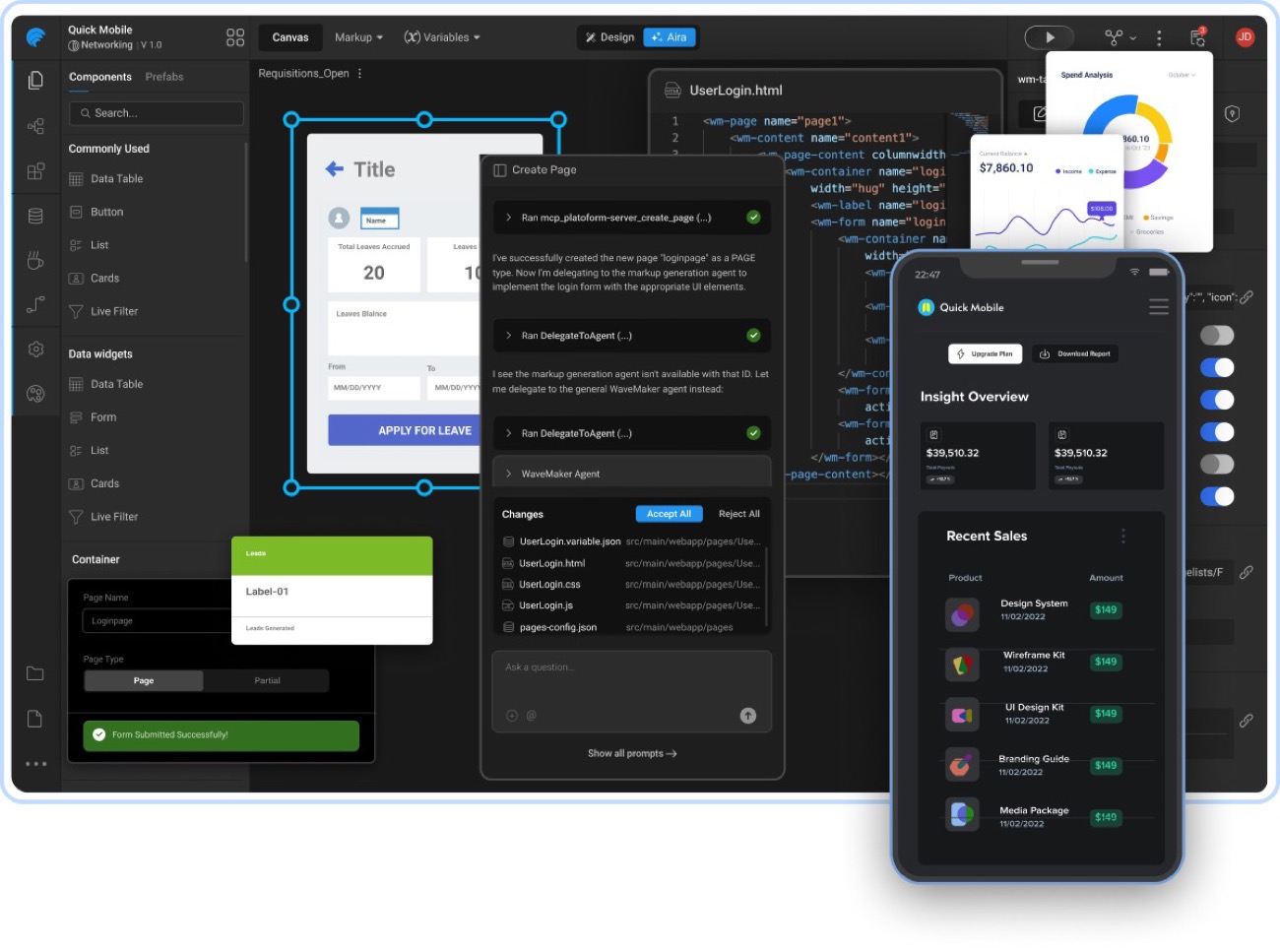
“WaveMaker’s Agentic Application Generation Platform is built for enterprise developer teams shipping production-grade web and native mobile applications. The core innovation is a two-pass architecture that separates what AI is great at from what AI is terrible at.”
“In the first pass, AI agents, constrained by a Model Context Protocol trained on a decade of production application patterns, convert design intent into WaveMaker Markup Language, or WML. This is a compact, structured, language-agnostic intermediate representation. In the second pass, a proven template-based code generator converts WML into production-ready code: Angular, React, or React Native on the frontend, Spring and Hibernate on the backend. Same input, same output, every time. No hallucinations, no phantom dependencies.”
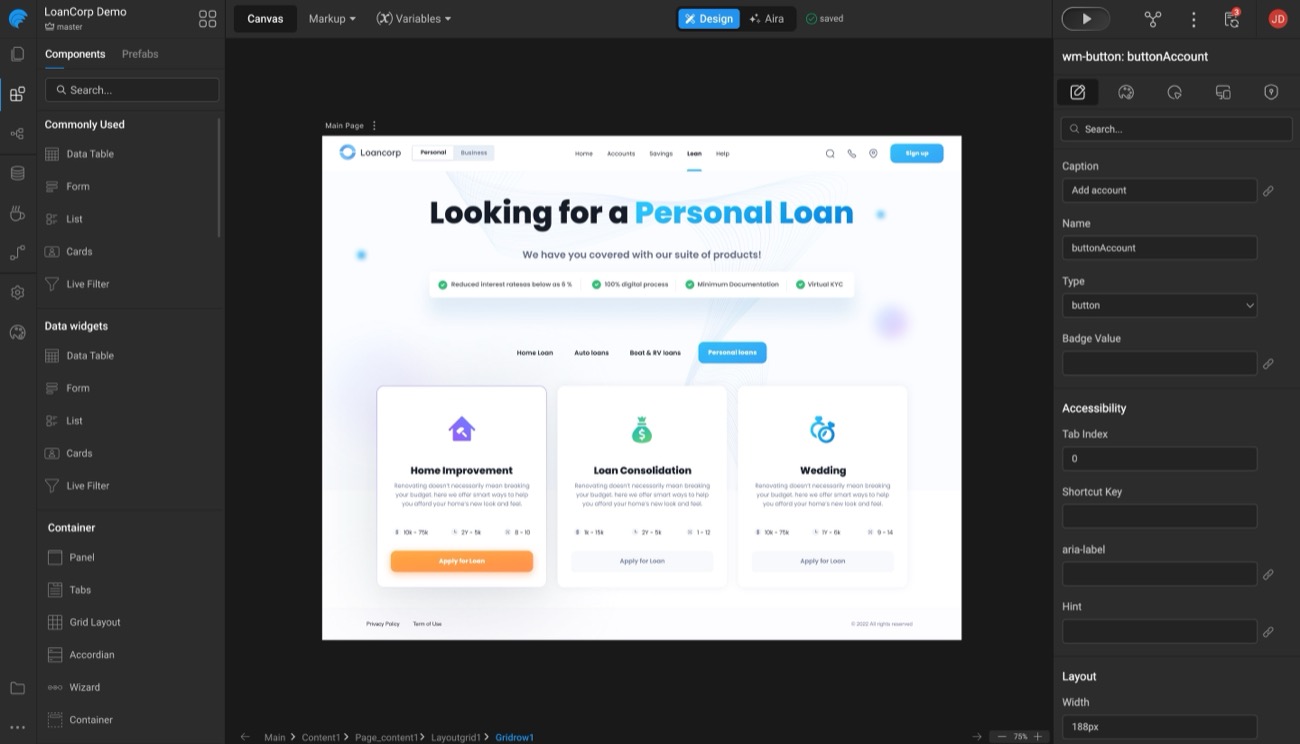
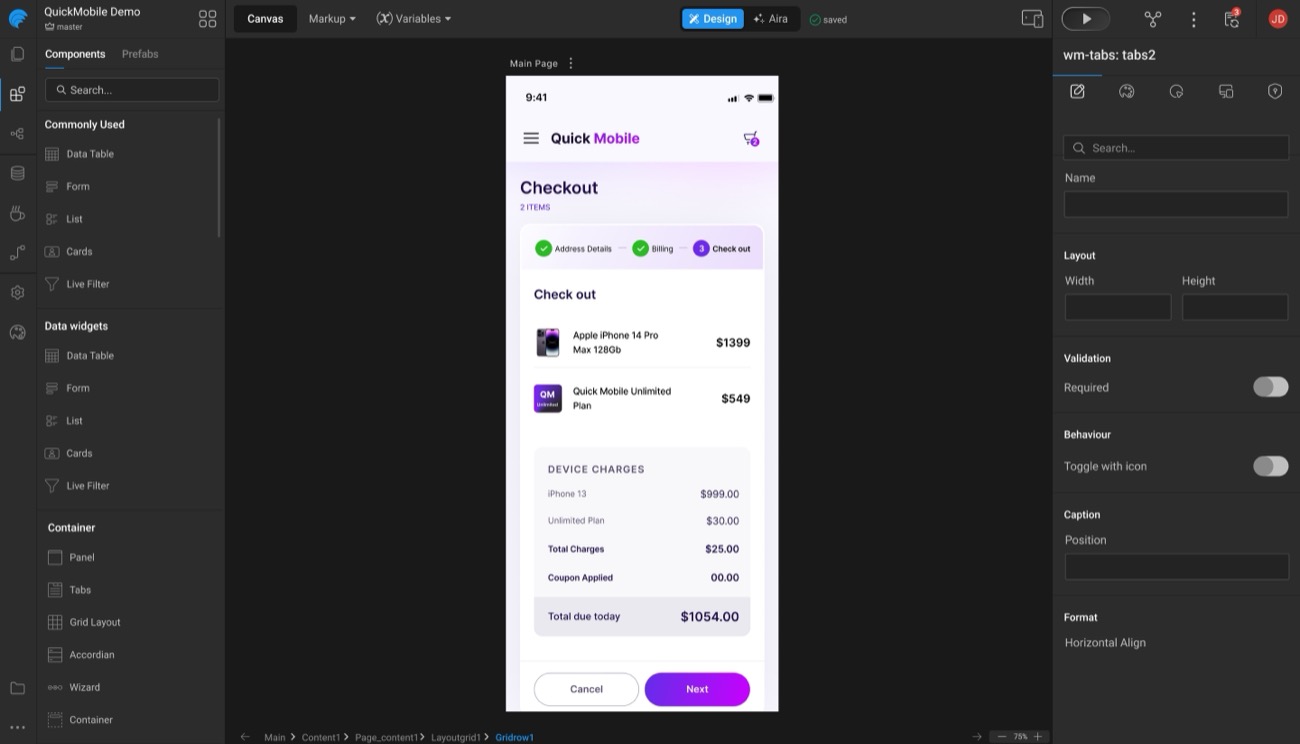
“Around that core architecture, we deliver: Design-to-Code agent, a Figma plugin for design-to-code conversion with full design token propagation; a rich enterprise UI component library built on Material 3; a visual WYSIWYG Studio where developers can toggle between agent mode, visual mode, and code editor mode; built-in security configuration covering RBAC, SSO, OAuth, and MFA; API integration via Open API and Swagger; and native Git and CI/CD pipeline support. The generated code is standard open-source frameworks that are downloadable, deployable anywhere, with zero runtime lock-in.”
Challenges Faced
Have you faced any challenges in your sector recently? Srivats acknowledged:
“The biggest challenge has been navigating the gap between AI coding hype and enterprise reality. The market narrative in 2024-25 was intoxicating: AI will write all the software, everyone becomes a programmer, development costs drop to near zero. That narrative attracted enormous venture funding and media attention to tools like Cursor, Copilot, Replit, and v0.”
“But enterprise teams who adopted these tools encountered a set of problems the hype cycle glossed over. AI-generated code introduces 1.7 times more issues than human-written code. Security flaws appear in 45% of AI output. 67% of developers report spending more time debugging AI-generated code than writing it themselves. Google’s own DORA report showed a 7.2% drop in delivery stability among teams using AI tools.”
“For WaveMaker, the challenge was positioning ourselves in a market where “AI coding” had become synonymous with raw, non-deterministic code generation when our approach was architecturally different. We had to educate the market that speed without reliability isn’t acceleration, it’s chaos with better marketing. The two-pass architecture, the constrained markup layer, the deterministic second pass, these are the concepts that required explanation in a world conditioned to judge AI tools by how fast they produced code. We overcame it by leaning into thought leadership, publishing research, and letting architecture speak for itself in customer evaluations.”
Evolution Of The Company’s Technology
How has the company’s technology evolved since launching? Srivats noted:
“WaveMaker started as a WYSIWYG, open-standards development studio, which is essentially a visual IDE that generated real Java and Angular code instead of proprietary artifacts. That was already differentiated in the low-code market, but it was fundamentally a visual development tool.”
“The first major evolution was adding a native mobile application studio. We delivered a React Native code generation engine for our enterprise customers and software companies who wanted to deliver a cross-platform companion or deskless high-fidelity application to their users or customers. The second was the composable architecture, enabling teams to build reusable components and assemble enterprise applications from modular building blocks, including supporting micro-frontend patterns.”
“The most consequential evolution came in 2025-26 with the introduction of AI agents and the two-pass architecture. Rather than adding AI as a chatbot sidebar, which is what most platforms did, we rearchitected the generation pipeline. We leaned in on our WaveMaker Markup Language (WML) as an intermediate representation, constrained AI through MCP, and kept the deterministic code generator as the final pass. This wasn’t an incremental feature; it was a fundamental architectural decision that redefined what the platform is: from a visual development studio to an agentic application generation platform. The Figma-to-app pipeline, the agent framework for custom domain-specific agents, and the style workspace for design system management were all built on top of this new architecture.”
Significant Milestones
What have been some of the company’s most significant milestones? Srivats cited:
“Several milestones stand out across our history. In 2014, we launched WaveMaker Online as one of the first cloud-based developer studios using Docker container orchestration provisioning developer workspaces in seconds, which was pioneering at the time. Building a customer base across 17 countries with enterprise clients like FICO, FIS, and AT&T validated that professional developers would adopt a platform that respected their code ownership. In 2023, WaveMaker was recognized by five industry analysts in a single year, including a position in the Omdia Universe for No Code/Low Code Solutions. In February 2025, we launched our AI-powered Figma-to-code plugin. In February 2026, we officially entered the agentic era with the launch of the two-pass architecture and the full agentic platform. That same month, our WaveXD 5G-integrated application marketplace won the Juniper Research Future Digital Award for Telco Innovation. And our collaboration with AT&T on mobile application experiences for influencer MVNOs opened an entirely new market vertical. Today, applications built using WaveMaker’s platform are shipping to millions of end users and consumers in the U.S. and globally.”
Customer Success Stories
Can you share any specific customer success stories? Srivats highlighted:
“For some of our customers who are large US public corporations in financial services and telecommunications, delivering to their exacting requirements around integration, UX, performance, security, and architectural governance in themselves has been a tremendous success. In a particular case, WaveMaker’s powered a mobile-first digital banking platform that is being used by millions of consumers with very high app store ratings. That is what we mean by enterprise-grade and consumer-scale, especially in these regulated industries where the code quality, security posture, and architectural consistency of generated applications isn’t optional, it’s audited.”
“We have helped Indonesia’s state owned petrochemical company completely rearchitect and migrate from over a 100 legacy Lotus Notes applications to a modern, rationalized Java/Angular based application stack within months. Belgium’s largest supermarket retailer, Colruyt Group, uses WaveMaker as a standardized accelerator for early developer teams, delivering architecture and guardrails out of the box. Blue Yonder, a global supply chain software leader, uses WaveMaker to support extensibility in areas of their supply chain solutions. These relationships span years, not quarters, which is the real test of an enterprise platform. Our enterprise customer base has experienced minimal churn which tells you more about product-market fit than any marketing metric.”
Funding/Revenue
Are you able to discuss funding and/or revenue metrics? Srivats said:
“WaveMaker is a Pramati group company, and Pramati has been self-funded for over two decades with group company revenues and proceeds from M&A. It gives us the freedom to make product decisions based on what’s right for customers on a multi-year horizon.”
“Pramati’s track record includes building and exiting multiple portfolio companies: Qontext (social platform for enterprise collaboration) was acquired by Autodesk, Imaginea (Cloud services) was acquired by Accenture, and SpotCues (deskless worker platform) was acquired by UKG in 2022. These exits demonstrate the ability to build durable products that attract acquirers, while the parent company maintains independence and continues investing in new ventures.”
“WaveMaker has grown net subscriptions every year since 2016. Our licensing model is annual subscriptions based on developer seats, with zero runtime fees which means our revenue scales with customer adoption, not with production usage metering. We currently serve customers across 17 countries.”
Total Addressable Market (TAM)
What total addressable market (TAM) size is the company pursuing? Srivats assessed:
“The global enterprise application market is projected to grow from $320 billion to $626 billion by 2030, according to some estimates. Within that, the AI code generation market is expected to reach approximately $25 billion by 2030. WaveMaker sits at the intersection of both: enterprise application development accelerated by AI.”
“Our specific addressable market is in midmarket with early developer teams building custom, UI-heavy, multi-platform web and mobile applications, particularly in financial services, insurance, telecommunications, supply chain, and enterprise software. These are organizations with 5 to 500 developers who need production-grade output, architectural governance, and predictable costs not weekend prototyping tools or individual coding accelerators.”
Differentiation From The Competition
What differentiates the company from its competition? Srivats affirmed:
“The competitive landscape segments into four categories, and WaveMaker occupies a distinct position in each comparison.”
“Against coding accelerators like Cursor and Claude Code: they make individual senior developers faster; WaveMaker normalizes output quality across entire teams through constrained markup generation and deterministic code output. They have no design system awareness; we treat design systems as first-class architectural artifacts.”
“Against vibe coding platforms like v0 and Lovable: they excel at beautiful prototypes; WaveMaker is built for production. They’re locked to specific ecosystems (v0 to Vercel/Next.js); we generate standard code deployable anywhere.”
“Against design-to-code tools like Locofy: they convert Figma to frontend code; WaveMaker goes full-stack, frontend, backend, API integration, security, deployment, all from a single specification.”
“Against enterprise low-code platforms like OutSystems: they require proprietary runtimes and certified developers; WaveMaker generates standard Angular, React, React Native, and Spring Boot with zero lock-in. Any Java/JavaScript developer can work with our output.”
“The unique combination of deterministic output, design system governance, full-stack generation, multi-platform targeting, and zero runtime lock-in exists nowhere else in this landscape simultaneously.”
Future Company Goals
What are some of the company’s future goals? Srivats emphasized:
“Near-term, we’re focused on expanding early access adoption for the agentic platform and demonstrating the two-pass architecture in production customer environments. We want enterprise teams to experience firsthand what it means to go from Figma design to deployed multi-platform application with deterministic, auditable code.”
“We’re deepening our agent framework so organizations can build custom domain-specific agents that inherit the same reliability guarantees — imagine a financial compliance agent or a supply chain integration agent that produces governed, deterministic output for highly specialized workflows.”
“On the market side, we’re expanding our system integrator partner ecosystem and strengthening our presence in financial services, insurance, telecommunications, and supply chain.”
“Longer-term, we believe the enterprise application development market is heading towards an agent-driven generation model with guardrails and architecture built-in — where AI composes interfaces dynamically from governed component libraries, adapting to each user’s context and role. WaveMaker’s design system infrastructure and WML architecture are the foundation for that future. We’re building toward it deliberately.”
Additional Thoughts
Any other topics you would like to discuss? Srivats concluded:
“One thing I think about a lot, borrowing from a recent article authored by my colleague and CTO, Deepak Anupalli, is the paradox of UX in the AI era. There’s a widespread assumption that AI will simplify interfaces to the point where design doesn’t matter. The reality is the opposite.”
“As AI automates away the easy, repetitive interactions such routine data entry, and simple form filling and what remains are the high-stakes decisions: a wealth advisor approving a million-dollar portfolio rebalancing, a supply chain manager responding to a stockout alert, a compliance officer reviewing an AI-generated audit narrative. These interactions don’t need less design; they need profoundly better design. The UX becomes the trust surface.”
“Enterprise applications typically blend five distinct interaction types — transactional, exploratory, data entry, analytical, and adaptive agentic — each with different trust requirements. A single generic AI-generated UI cannot serve them all. That’s why WaveMaker’s design-governed approach matters: we ensure that each interaction type gets the trust-appropriate UX treatment it requires, enforced through the generation pipeline rather than hoped for through documentation.”
“I believe the companies that understand this – that design is the guardrail AI needs, not decoration AI replaces — are the ones that will build lasting enterprise software in this era. That’s the thesis WaveMaker is built on, and it’s what drives me each day.”
